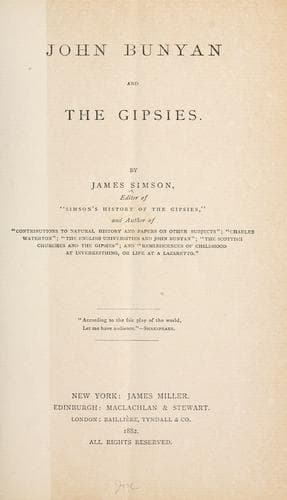
Bunyan, John, 1628-1688 -- Relations with Romanies; Leland, Charles Godfrey, 1824-1903; Romanies
But what I wish more particularly to allude to is Mr. Leland’s discovery
that the Gipsies are a tribe from India that are known there under the
name of “Syrians,” and therefore not originally natives of India; which
latter conclusion, however, he does not admit, but accounts for the
phenomenon in this way:—“I offer as an hypothesis that bands of Gipsies
who roamed from India to Syria have, after returning, been called Trablûs
or Syrians, just as I have known Germans after returning from the
fatherland to America to be called Americans” (p. 338). That is, a
family or company of Indian nomads returning from a visit to Syria would
afterwards be called, and cause the whole of the race who never left
India to be called, Syrians for ever! Again he says:—“It will probably
be found that they are Hindoos who have roamed from India to Syria and
back again, here and there, until they are regarded as foreigners in both
countries” (!). The allusion to Germans in illustration is not merely
inapplicable, but unintelligible. Of the “Syrians” in India Mr. Leland
writes:—“Whether they have or had any connection with the migration to
the West we cannot establish” (p. 339). For this reason he should not
have identified them with the Gipsies out of India. “Their language and
their name would seem to indicate it; but then it must be borne in mind
that the word _rom_, like _dom_, is one of wide dissemination, _dum_
being a Syrian Gipsy word for the race” (p. 339); and “among the Copts . . .
the word for man is _romi_” (p. 20). {12} “Among the hundred and
fifty wandering tribes of India and Persia . . . it is of course
difficult to identify the exact origin of the European Gipsy” (p. 18).
For that reason he should not have written so positively that he had
“definitely determined the existence in India of a peculiar tribe of
Gipsies who are _par eminence_ the Romanys of the East, and whose
language is there what it is in England, the same in vocabulary and the
chief slang of the roads. This I claim as a discovery, having learned it
from a Hindoo who had been himself a Gipsy in his native land” (Pref.
iv.). He describes them as “thieves, fortune-tellers and vagrants” (p.
339), yet his informant, John Nano, said he was, or had been, one of
them; which would imply that there were different kinds of “Syrians,”
inasmuch as he was found to be a maker of curry powder in London, and the
husband of an English woman, a Mahometan by religion, and sufficiently
educated to have written an autobiography, which had unfortunately been
burnt. According to John’s account, these “Syrians” were “full blood
Hindoos, and not Syrians,” and he “was very sure that his Gipsies were
Indians.” The term “full-blood Hindoos” who are “thieves,
fortune-tellers and vagrants,” and strollers out of and back to India,
requires explanation. John’s information as to these people being called
by the other natives of India “Syrians” may be very reliable; but that
Public-domain text, read in full here on John Shaqi.
Reviews
Reviews
No reviews yet
Be the first to share your thoughts on this work.
Join the Discussion
Join the discussion
Sign in to leave a comment or review.
Sign InorCreate an account