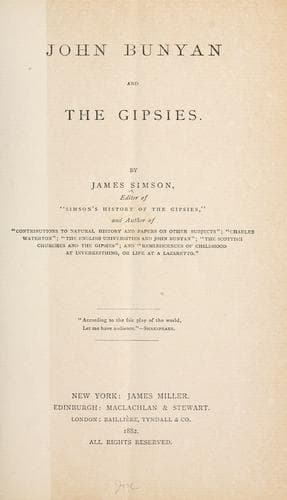
Bunyan, John, 1628-1688 -- Relations with Romanies; Leland, Charles Godfrey, 1824-1903; Romanies
they were “full-blood Hindoos” could have been, at its best, nothing but
a supposition on his part. As I said in the Introduction to the _History
of the Gipsies_, “I can conceive nothing more difficult than an attempt
to elucidate the history of any of the infinity of sects, castes or
tribes to be met with in India” (p. 41). The nature of the population of
India is such that there would hardly be a possibility of its people at
large becoming acquainted with the movements of a few families of
outcasts leaving their race behind and going to and returning from Syria
(if they ever did that), so as to give the whole race the name of
Syrians. The name must have had its origin from the people having come
originally from Syria, or from parts surrounding it.
In _The Gipsies_ Mr. Leland says that he has “carefully read everything
ever printed on the Romany” (Pref. v.); and that it is his “opinion that
one ought, when setting forth any subject, to give quite as good an
opportunity to others who are in our business as to ourselves” (p. 88).
And yet, although he made exclusive use of the work I edited and
published for parts of his article in _Johnson’s Cyclopædia_, and has
alluded to Messrs. Borrow, Smart, Palmer and Groome, he has carefully
abstained from mentioning my name, however much he may have been indebted
to my work. By referring to it, he cannot but remember having “carefully
read” the following:—
“I am inclined to believe that the people in India corresponding to
the Gipsies in Europe will be found among those tented tribes who
perform certain services to the British armies; at all events there
is such a tribe in India who are called Gipsies by the Europeans who
come in contact with them. A short time ago, one of these people,
who followed the occupation of a camel driver, found his way to
England, and ‘pulled up’ with some English Gipsies, whom he
recognized as his own people; at least he found that they had the
ways and ceremonies of them. But it would be unreasonable to suppose
that such a tribe in India did not follow various occupations” (p.
40). “What evidently leads Mr. Borrow and others astray in the
matter of the origin of the Gipsies, is that they conclude that
because the language spoken by the Gipsies is apparently, or for the
most part, Hindostanee, therefore the people speaking it originated
in Hindostan; as just a conclusion as it would be to maintain that
the Negroes in Liberia originated in England because they speak the
English language!” (p. 41). [Mr. Leland alludes to this simile by
saying that English spoken by American Negroes does not prove Saxon
descent (p. 20).]
Public-domain text, read in full here on John Shaqi.
Reviews
Reviews
No reviews yet
Be the first to share your thoughts on this work.
Join the Discussion
Join the discussion
Sign in to leave a comment or review.
Sign InorCreate an account