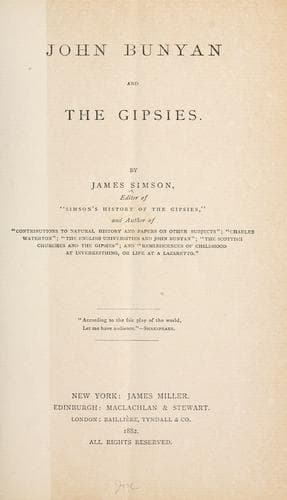
Bunyan, John, 1628-1688 -- Relations with Romanies; Leland, Charles Godfrey, 1824-1903; Romanies
I admit this of Mr. Leland, that, by availing himself of the hard labours
of others, at least to give him a start, he has added greatly to our
knowledge of the Gipsy language, so far as I know and can judge; but that
is nearly all that can be said of him. What he has told us of the
information got from a native of India as to the Gipsies there being
called “Syrians” shows that he was merely in good luck in falling in with
the man from whom he obtained it; while, if it is reliable, it confirms
my conjecture, although of that it does not seem to have been his
business to inform the world. His chapter on the “Shelta or Tinkers’
Talk,” picked up also as it were by accident from a stray tinker, is
indeed of great interest; but the world has reason to question his
judgment when he says that “it is, in fact, a language, for it can be
spoken grammatically, and without using English or Romany” (p. 371).
Another occasion for questioning his judgment is when he says that “Mr.
[Walter] Simson, had he known the ‘Tinklers’ better, would have found
that, not Romany, but Shelta was the really secret language which they
employed, although Romany is also more or less familiar to them all” (p.
371); for almost anyone by reading the _History_ can see the absurdity of
it. {15}
This book of Mr. Leland (although described in the Preface as “Sketches
of experiences among the Gipsies”), to justify its title of _The
Gipsies_, should have been constructed on some plan and scientifically
arranged, with a great variety of particulars, and no extraneous matter
or padding in it. In place of that we have little but random sketches or
scenes connected with the race. There is no principle running through
it, for we are told in the Introduction that
“The day is coming when there will be no . . . wild wanderers . . .
and certainly no Gipsies” (p. 15). And after describing how English
sparrows have driven so many kinds of native birds out of
Philadelphia, he says, “So the people of self-conscious culture and
the mart and factory are banishing the wilder sort . . . As a London
reviewer said when I asserted in a book that the child was perhaps
born who would see the last Gipsy, ‘Somehow we feel sorry for that
child’” (p. 15). And in describing English fairs, as represented by
that at Cobham, he says, “In a few years the last of them will have
been closed, and the last Gipsy will be there to look on” (p. 142).
Public-domain text, read in full here on John Shaqi.
Reviews
Reviews
No reviews yet
Be the first to share your thoughts on this work.
Join the Discussion
Join the discussion
Sign in to leave a comment or review.
Sign InorCreate an account