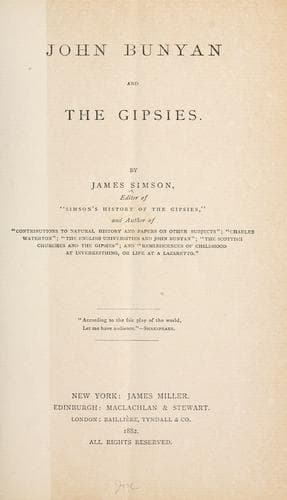
Bunyan, John, 1628-1688 -- Relations with Romanies; Leland, Charles Godfrey, 1824-1903; Romanies
“What becomes of the Gipsies is a question that cannot be settled by
reference to any of Mr. Borrow’s writings, although these contain a
few incidental remarks that throw some light on it when information
of a positive and circumstantial nature is added” (p. 120).
In offering to a London journal the double-article on _Mr. Leland on the
Gipsies_ I said, on the 30th May, 1882:—
“I admit that it is a very difficult and delicate matter for a
journal to ‘go back on’ a position once taken up on any question; but
I think that if you admit the intended article the point will be
gained, without any responsibility on the part of the journal or
editor;” and that the insertion of it would put the journal “in its
proper position before the world, without recanting anything.” I
further wrote that “Purely literary journals must necessarily labour
under great disadvantages when called on to notice a book on a very
special subject, unless they can find a writer who can do it for
them.”
If all that has been written on the Gipsies “ceasing to be Gipsies,”
under any circumstances, “be allowed to go uncontradicted, it will become
rooted in the public mind, and gather credit as time goes by, making it
daily more difficult to set it aside, and allow truth to take its
place”—as I wrote in reply to two fulsome eulogies on Charles Waterton.
There are various phenomena connected with the subject of the Gipsies;
not the least striking one being the popular impression about the
_extinction_ of the _race_ by its _changing its habits_, which has been
arrived at without investigation and evidence, and against all analogy
and the “nature of things.” So fully has this idea taken possession of
the public mind that a hearing on the true position of the question can
scarcely be had. One purpose this has served, that it has saved the
public almost every serious thought or care in regard to its duty towards
the race, and relieved it of every _ultimate_ responsibility connected
with it. But that is not a becoming position for any people to
occupy—that of getting rid of its obligations by ignoring them. In 1871
I wrote thus:—
“The subject of the Gipsies, so far as it is understood . . .
presents little interest to the world if it means only _a certain
style of life_ that may _cease at any moment_; in which case it would
be deserving of little notice.”
But all of the aspects connected with the popular idea of a Gipsy are of
interest and importance when they represent the primitive condition of a
people who sooner or later pass into a more or less settled condition,
and look back to the style of life of their ancestors. In this respect
the Gipsies differ from most of the wild races, inasmuch as they become
perpetuated, especially in English-speaking countries, by those of more
or less mixed blood. In regard to that I wrote thus in the Disquisition
on the Gipsies:—
Public-domain text, read in full here on John Shaqi.
Reviews
Reviews
No reviews yet
Be the first to share your thoughts on this work.
Join the Discussion
Join the discussion
Sign in to leave a comment or review.
Sign InorCreate an account