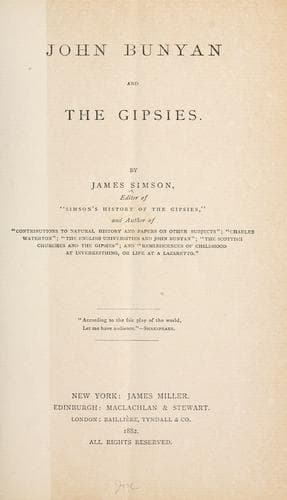
Bunyan, John, 1628-1688 -- Relations with Romanies; Leland, Charles Godfrey, 1824-1903; Romanies
“The fact of these Indians, and the aboriginal races found in the
countries colonized by Europeans, disappearing so rapidly, prevents
our regarding them with any great degree of interest. This
circumstance detracts from that idea of dignity which the perpetuity
and civilization of their race would inspire in the minds of others”
(p. 446).
If the “ordinary inhabitant” considers for a moment what his feelings are
for everything Gipsy, so far as he understands it, he will realize in
some degree the responding feelings of the Gipsies, whatever their
positions in life. These create two currents in society—the native and
the Gipsy; so that the Gipsy element by marrying with the Gipsy element,
or in the same way drawing in and assimilating the native blood with it,
keeps the Gipsy current in full flow, and distinct from the other. The
Gipsy element, mixed as it is in regard to blood, never having been
acknowledged, necessarily exists incognito, and in an outcast condition,
however painful it is to use such an expression towards people that have
lived so long in the British Isles, and are frequently of unquestionable
standing in society; with nothing, in many instances, to distinguish them
outwardly from the rest of the population, but possessing signs and
words, and a cast of mind peculiar to themselves, that is, a sense of
tribe and a soul of nationality, which remain with their descendants.
This subject is not conventional, but will doubtless sooner or later
become such, as there are things conventional to-day that were not such
lately. In that respect the discussion or even the sentiments of a
prominent person or journal can make a thing conventional; such is the
nature of a highly complex society anywhere. With reference to this
matter I wrote to the journal alluded to in the following terms:—
“Surely the strange and unfortunate Gipsy race and its various
off-shoots have not sinned beyond the forgiveness of the rest of
their fellow-creatures, so that what represents a relatively-large
body of British subjects cannot be acknowledged even by name; leaving
to others to look upon or associate with them as each member of the
native race may see fit.”
One would naturally think that the inhabitants of Great Britain would at
least take some little interest in what might be called their “coloured
population;” and hold in respect _some_ of its members who could
doubtless tell us much that is interesting on the subject of the Gipsies,
so that that should not be a reproach to them which would be a credit to
others. To do so, and have the people, in some form or other,
acknowledged, is due to the spirits of research and philanthropy that
characterize this age. I admit that there are many difficulties
attending a movement of this kind. These I have explained fully on
previous occasions, and I need not repeat them here.
Public-domain text, read in full here on John Shaqi.
Reviews
Reviews
No reviews yet
Be the first to share your thoughts on this work.
Join the Discussion
Join the discussion
Sign in to leave a comment or review.
Sign InorCreate an account