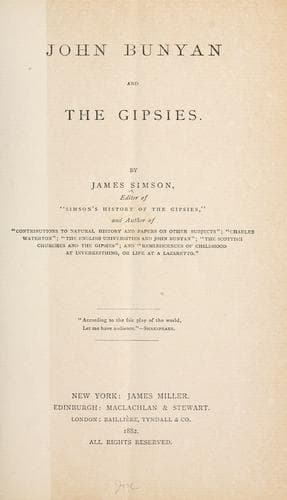
Bunyan, John, 1628-1688 -- Relations with Romanies; Leland, Charles Godfrey, 1824-1903; Romanies
{7} These two letters, dated the 5th and 19th of May, 1882, were in
answer to a short one from a clergyman of the Church of England,
acknowledging the receipt of a copy of my _Reminiscences of Childhood_,
_etc._, which contained an Appendix on John Bunyan and the Gipsies.
{11a} The text represents the article as originally written.
{11b} I endeavoured, unsuccessfully, to get another reading of this book
before saying that “no reference was made in it to mine.” I alluded,
from memory, to _my_ part of it. On examination I find that the only
indirect reference to it is the following:—“Mr. Simson, in his _History
of the Gipsies_ [that is, in the _Disquisition on the Gipsies_] asserts
that there is not a tinker or scissors-grinder in Great Britain that
cannot talk this language; and my own experience agrees with his
declaration, to this extent—that they all have some knowledge of it, or
claim to have it, however slight it may be,” (p. 4). I did not express
myself so absolutely as represented by Mr. Leland, who did not see fit to
mention the double authorship of the book; the subject of which I took up
from where it was left by Walter Simson. This double authorship may
prove a little confusing to the reader when the book is alluded to.
{11c} See second note at page 19.
{12} In _The English Gipsies_, _etc._, Mr. Leland writes:—“I asked a
Copt scribe if he were Muslim, and he replied, ‘_La_, _ana Gipti_’ (‘No,
I am a Copt’) pronouncing the word _Gipti_, or Copt, so that it might
readily be taken for ‘Gipsy.’ And learning that _romi_ is the Coptic for
a man, I was again startled; and when I found _tema_ (tem, land) and
other Romany words in ancient Egyptian (_vide_ Brugsch. _Grammaire_,
_etc._) it seemed as if there were still many mysteries to solve in this
strange language.” Of some Egyptian Gipsies Mr. Leland says that “they
all resembled the one whom I have described . . . They all differed
slightly, as I thought, from the ordinary Egyptians in their appearance”
(p. 193).
{14} Tacitus makes Caius Cassius, in the time of Nero, say:—“At present
we have in our service whole nations of slaves, the scum of mankind,
collected from all quarters of the globe; a race of men who bring with
them foreign rites, and the religion of their country, _or probably no
religion at all_.”—_Murphy’s Translation_.
{15} Perhaps the most interesting scene connected with the Gipsy
language in Scotland, given in the _History_, is that at St. Boswell’s
(pp. 309–318). The word “Tinkler,” assumed by and applied to the Scotch
Gipsies, seems to have been used from a desire to escape the legal
responsibility attaching to the word “Gipsy.”
Public-domain text, read in full here on John Shaqi.
Reviews
Reviews
No reviews yet
Be the first to share your thoughts on this work.
Join the Discussion
Join the discussion
Sign in to leave a comment or review.
Sign InorCreate an account