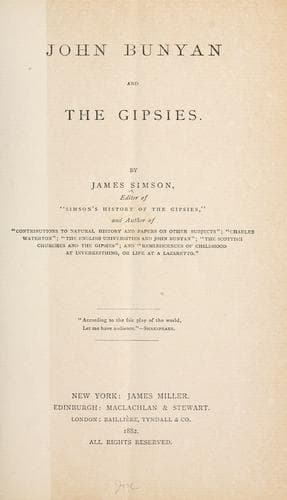
Bunyan, John, 1628-1688 -- Relations with Romanies; Leland, Charles Godfrey, 1824-1903; Romanies
{16} It is not only puzzling, but provoking to decide how to treat a
writer like Mr. Leland, for sometimes he shows a great deal of knowledge
of his subject, and sometimes apparently nothing of it—one assertion
contradicting another on the same question. What in reality has an
antipathy between birds, or the idea of “people of self-conscious culture
and the man and factory,” or the destiny of the American Indians to do
with the destiny of the Gipsies? For he says, “Gipsies in England are
passing away as rapidly as Indians in North America” (_The English
Gipsies_, _Pref. X._). As a native of the United States, Mr. Leland must
know that these Indians become extinct, and of the Gipsies in England
that although there are comparatively few “dwellers in tents” of full
blood, so called, there are many, many thousands of more or less mixed
blood following various callings, or in various positions in life, as he
has frequently admitted. The distinction between “old-fashioned” Gipsies
and other members of the tribe is but trifling with the subject.
The following extracts from _The English Gipsies and their Language_ are
interesting:—
“Other writers have had much to say of their incredible distrust of
_Gorgios_ and unwillingness to impart their language, but I have
always found them obliging and communicative” (Pref. V.).—“In every
part of the world it is extremely difficult to get Romany words even
from intelligent Gipsies, _although they may be willing with all
their heart to communicate them_” (p. 17).—“Now the reader is
possibly aware that of all difficult tasks, one of the most difficult
is to induce a disguised Gipsy, or even a professed one, to utter a
word of Romany to a man not of the blood” (p. 37).—“Be it remembered,
reader, that in Germany, at the present day, the mere fact of being a
Gipsy is still treated as a crime” (p. 74).—“Though the language of
the Gipsies has been kept a great secret for centuries, still a few
words have in England oozed out here and there from some unguarded
crevice” (p. 78).—“The very fact that they hide as much as they can
of their Gipsy life and nature from the _Gorgios_ would of itself
indicate the depths of singularity concealed beneath their apparent
life” (p. 153).—“Behind it all . . . . the fierce spirit of social
exile from the world in which they lived . . . and the joyous
consciousness of a secret tongue and hidden ways” (p. 156).—“A
feeling of free-masonry, and of guarding a social secret, long after
they leave the roads and become highly reputable members of society.
But they have a secret, and no one can know them who has not
penetrated it” (p. 174).
Public-domain text, read in full here on John Shaqi.
Reviews
Reviews
No reviews yet
Be the first to share your thoughts on this work.
Join the Discussion
Join the discussion
Sign in to leave a comment or review.
Sign InorCreate an account