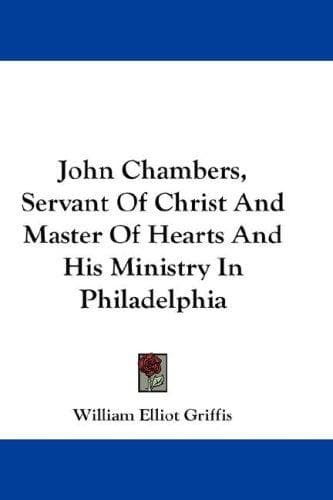
John Chambers, Servant of Christ and Master of Hearts, and His Ministry in PhiladelphiaGriffis, William Elliot
Religion
John Chambers, Servant of Christ and Master of Hearts, and His Ministry in Philadelphia
Griffis, William Elliot
Chambers, John, 1797-1875
Above all, this young Irish-American lad had a big, warm heart. As
he read the Scriptures for himself he was early filled with that
idea, which afterwards he infused into the lives of thousands,
that the gospel is a glorious message to the individual, that the
Christian life is a Way, as well as a belief, that there are elements
in religious life and experience which do not submit to exact
definitions, and that the mercy of God is the largest factor of the
Divine life toward wrong-doing man. In this the time of his youth,
as well as all through his life, he felt deeply rather than thought
coolly. Whether we must ascribe most or all of the results to the
towering personality of his teacher, John Mason Duncan, and of his
long continued training at a most susceptible age under so forceful
a master, certainly, whatever our philosophy of the known facts may
be, he was filled with an antipathy to creeds. In a time and climate
of theological severity, and amid the rancor of controversy, he was,
among his clerical brethren who set higher value than he did, upon
"the form of sound words" or logical formulas, verily a pilgrim and
stranger upon the earth. He rejoiced to see by faith the day we live
in, even the work of the General Assembly, and of the Synods and
Presbyteries of 1903.
Ever hoping and praying for the day to come when the creeds,
especially of the Presbyterian body of churches, in which he had
been educated, would be revised, he lived and "died in faith, not
having received the promises, but having seen them and greeted them
from afar". The change of theological climate, the revision of the
Westminster symbols and the simplification of theology into which we,
in this twentieth century have come, even the work of the General
Assembly, that met in New York in 1902, and in Los Angeles in 1903,
was what he in hope long ago looked for. He believed in expressing
forms of faith in the language of living men, not of dead ones, for he
ever taught not only that God was, but that He is.
Public-domain text, read in full here on John Shaqi.
Reviews
Reviews
No reviews yet
Be the first to share your thoughts on this work.
Join the Discussion
Join the discussion
Sign in to leave a comment or review.
Sign InorCreate an account