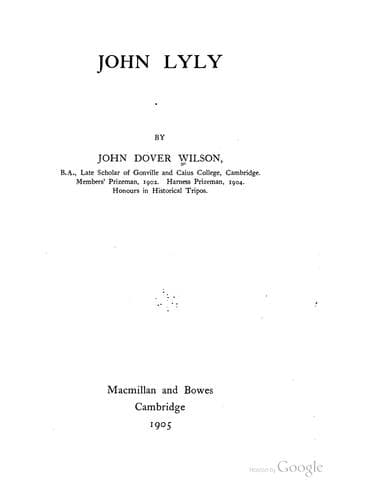
Lyly, John, 1554?-1606 -- Criticism and interpretation
In every way _Euphues and his England_ is an improvement upon its
predecessor. The story and plot are still weak, but the situations are
often well thought out and treated with dramatic effect. The action
indeed is slow, but it moves; and in the story of Fidus it moves
comparatively quickly. Such motion of course can scarcely ruffle the
mental waters of those accustomed to the breathless whirlwinds which
form the heart of George Meredith's novels; but these whirlwinds are as
directly traceable to the gentle but fitful agitation of _Euphues_, as
was the storm that overtook Ahab's chariot to the little cloud
undiscerned by the prophet's eye. The figures, again, that move in
Lyly's second novel are no longer clothes filled with moral sawdust. The
character of Philautus is especially well drawn, though at times blurred
and indistinct. Lyly had not yet passed the stage of creating types,
that is of portraying one aspect and an obvious one of such a complex
thing as human nature. But a criticism which would be applicable to
Dickens is no condemnation of an Elizabethan pioneer. It was much to
have attempted characterization, and in the case of Philautus, Iffida,
Camilla, and perhaps "the Violet" the attempt was nearly if not quite
successful. It is noticeable that for one who was afterwards to become a
writer of comedy, Lyly shows a remarkable absence of humour in these
novels. Now and again we seem trembling on the brink of humour, when the
young wiseacre is brought into contact with his weak-hearted friend, but
the line is seldom actually crossed. Wit, as Lyly here understood it,
had nothing of the risible in it; for it meant to him little more than a
graceful handling of obvious themes.
Public-domain text, read in full here on John Shaqi.
Reviews
Reviews
No reviews yet
Be the first to share your thoughts on this work.
Join the Discussion
Join the discussion
Sign in to leave a comment or review.
Sign InorCreate an account