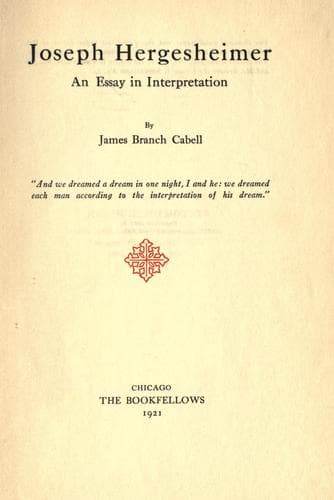
Joseph Hergesheimer, an essay in interpretation — John Shaqi
Joseph Hergesheimer, an essay in interpretationCabell, James Branch
General
Joseph Hergesheimer, an essay in interpretation
Cabell, James Branch
Hergesheimer, Joseph, 1880-1954 -- Criticism and interpretation
Now of course, like virtually every other practise of “realism,” this
is untrue to life: nobody does in living regard adjacent objects as
attentively as the reader of a Hergesheimer story is compelled to note
them. For one, I cannot quite ignore this fact, even when I read with
most delight: and I sometimes wonder if Mr. Hergesheimer premeditatedly
sits down to study an andiron or a fan for literary use, or whether his
personal existence is actually given over to this concentration upon
externals and inanimate things. But he was once a painter; and large
residuals of the put-by art survive.
All this results, of course, in a “style” to which the reader is never
quite oblivious. The Hergesheimer dramas—dramas wherein each of the
players has a slight touch of fever—are enacted, with a refining hint
of remoteness, behind the pellucid crystal of this “style,” which
sharpens outlines, and makes colors more telling than they appear to
everyday observation, and brings out unsuspected details (seen now for
the first time by the reader, with a pleasurable shock of delight), and
just noticeably glazes all.
The Hergesheimerian panorama is, if I may plagiarize, a little truer
than truth: and to turn from actual life to Joseph Hergesheimer’s pages
arouses a sensation somewhat akin to that sustained by a myopic person
when he puts on spectacles...
And thus is a quite inoffensive tropic town foredoomed to be a
perennial source of disappointment to all tourists who have previously
read _San Cristóbal de la Habana_,—that multi-colored sorcerous
volume, with which we have here no immediate concern,—and who, being
magic-haunted, will over-rashly bring to bear upon a duly incorporated
city, thriftily engaged in the tobacco and liquor-business, their eyes
unre-enforced.
NINE
Such, then, are this artist’s materials: in a world of extraordinary
vividness a drama of high questing foiled, a tragedy of beauty
sought, with many blunders but single-mindedly, by monomaniacs,—in
fine, a performance suggestively allied, in its essentials, to the
smaller-scaled and unaudienced drama of the young man with the
percipient eyes of a painter, who throughout fourteen years was
striving to visualize in words his vision of beauty, and who was
striving to communicate that vision, and who—the tastes of the average
man being that queer slovenly aggregation which makes the popular
periodical popular, and the ostensible leaders of men being regular
subscribers to the slatternly driveling host—was striving in vain.
These things are but the raw materials, I repeat,—the bricks and mortar
and the scantlings,—for, of course, there is in Joseph Hergesheimer’s
books far more than plot or thought, or even “style”: there is that
indescribable transfiguring element which is magic.
Public-domain text, read in full here on John Shaqi.
Reviews
Reviews
No reviews yet
Be the first to share your thoughts on this work.
Join the Discussion
Join the discussion
Sign in to leave a comment or review.
Sign InorCreate an account