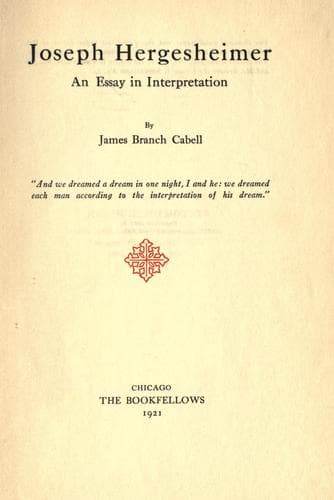
Joseph Hergesheimer, an essay in interpretation — John Shaqi
Joseph Hergesheimer, an essay in interpretationCabell, James Branch
General
Joseph Hergesheimer, an essay in interpretation
Cabell, James Branch
Hergesheimer, Joseph, 1880-1954 -- Criticism and interpretation
So it is quite conceivably the impurest sort of envy and low-mindedness
which causes me here to suspect alarming symptoms. I, in any event,
put aside _The Happy End_ with very real discomfort; and turn to the
reflection that Mr. Hergesheimer has since written _Linda Condon_,
which discomforts me quite as poignantly by exposing to me my poverty
in phrases sufficiently noble to apply to this wholly admirable book.
SEVEN
Yet Mr. Hergesheimer, even in the least worthy of his magazine stories,
writes really well. The phrase has an inadequate ring: but when you
have applied it without any grave reservation to Mr. Tarkington and
Mr. Hergesheimer, and have given Mrs. Wharton a deservedly high rating
for as many merits as seem possible to a woman writer, of what other
American novelists can this pardonably be said by anybody save their
publishers? No: the remainder of us, whatever and however weighty may
be our other merits, can manage, in this matter of sheer writing,
to select and arrange our adjectives and verbs and other literary
ingredients acceptably enough every now and then: and that is the
utmost which honesty can assert.
But Mr. Hergesheimer always writes really well, once you have licensed
his queer (and quite inexcusable) habit of so constantly interjecting
proper names to explain to whom his, Hergesheimer’s, pronoun
refers.... Perhaps I here drift too remotely into technicalities, and
tend to substitute for a consideration of architecture a treatise
upon brick-making. Even so, I cannot but note in this place how
discriminatingly Mr. Hergesheimer avoids the hurdles most commonly
taken with strained leaps by the “stylist,” through Mr. Hergesheimer’s
parsimony in the employment of similes; and how inexplicably he
renders “anything from a chimneypot to the shoulders of a duchess”
by—somehow—communicating the exact appearance of the thing described
without evading the whole issue by telling you it is like something
else.
EIGHT
Now this non-employment of time-approved devices seems even the more
remarkable when you consider how intensely Joseph Hergesheimer realizes
the sensuous world of his characters and, in particular, the optic
world. He is the most insistently superficial of all writers known to
me, in his emphasis upon shapes and textures and pigments.
His people are rendered from complexion to coat-tail buttons, and
the reader is given precisely the creasing of each forehead and the
pleating of their under-linen. Mr. Hergesheimer’s books contain whole
warehousefuls of the most carefully finished furniture in literature;
and at quaint bric-à-brac he has no English equal. It is all visioned,
moreover, very minutely. Joseph Hergesheimer makes you observe his
chairs and panelings and wall-papers and window-curtains with an
abnormal scrutiny. The scenery and the weather, too, are “done” quite
as painstakingly, but these are indigenous to ordinary novels.
Public-domain text, read in full here on John Shaqi.
Reviews
Reviews
No reviews yet
Be the first to share your thoughts on this work.
Join the Discussion
Join the discussion
Sign in to leave a comment or review.
Sign InorCreate an account