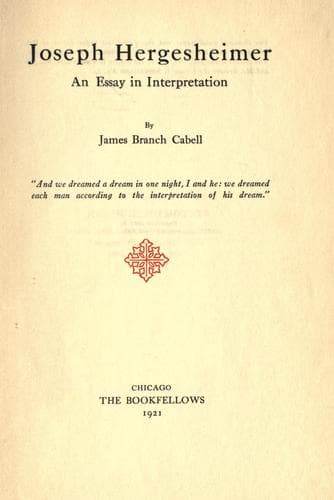
Joseph Hergesheimer, an essay in interpretationCabell, James Branch
General
Joseph Hergesheimer, an essay in interpretation
Cabell, James Branch
Hergesheimer, Joseph, 1880-1954 -- Criticism and interpretation
No, Mr. Hergesheimer’s monomania, one estimates, was then, just as it
seems to be to-day, to write for his own delectation—in large part
because he could not help it, and in part with the hope of, somehow
and some day, obtaining an audience with the same or, at any rate,
a kindred sense of beauty.... This, to be sure, is always a vain
aspiration. That which, in effusions such as this, we loosely talk
about as “beauty” probably does not exist as a vital thing save here
and there in the thoughts of not too many and not to be too seriously
taken persons. In life, rather frequently, one appears to catch a
glimpse of something of the sort just around the corner or over the
way, but it is rarely, and perhaps never, actually at hand. Sometimes,
of course, one seems about to incorporate the elusive thing into
one’s daily living; and, striving, finds the attempt a grasping at
an opalescent bubble, with the same small shock, the same disrupting
disillusionment.
“Beauty,” thus, is by the judicious conceded to be an unembodiable
thought, not even quite to be grasped by the mind; and certainly never
nicely nor with any self-content to be communicated via the pages
of a book, wherein are preserved, at best, the faded petals and the
flattened crumbling stalks of what seemed lovely once to somebody who
is as dead as are these desiccated relics of his ardor and of his
disputable taste.
In brief, it may be granted—and by Mr. Hergesheimer most cheerfully
of all persons—that during these fourteen years Mr. Hergesheimer was
attempting the preposterously impossible.
FOUR
Now, to my thinking, there is something curiously similar to that
unreasonable endeavor to be found in all the Hergesheimer novels.
Here always I find portrayed, with an insistency and a reiteration to
which I seem to detect a queer analogue in the writings of Christopher
Marlowe, men laboring toward the unattainable, and a high questing
foiled. No one of the five novels varies from this formula.
Public-domain text, read in full here on John Shaqi.
Reviews
Reviews
No reviews yet
Be the first to share your thoughts on this work.
Join the Discussion
Join the discussion
Sign in to leave a comment or review.
Sign InorCreate an account