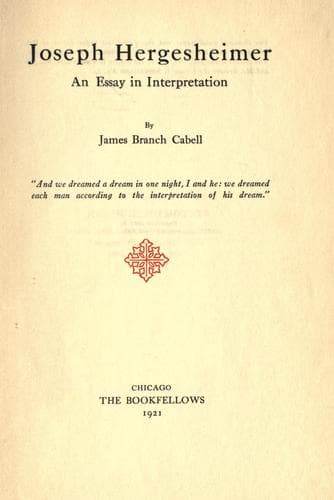
Joseph Hergesheimer, an essay in interpretation — John Shaqi
Joseph Hergesheimer, an essay in interpretationCabell, James Branch
General
Joseph Hergesheimer, an essay in interpretation
Cabell, James Branch
Hergesheimer, Joseph, 1880-1954 -- Criticism and interpretation
Anthony Ball, of _The Lay Anthony_, strives toward the beauty of
chastity—not morally concerned one way or the other, but resolute to
preserve his physical purity for the sake of a girl whose body, he
finds at last, has long ago been ravished by worms. Again there is in
_Mountain Blood_ no hint of moral-mongering—for Mr. Hergesheimer is
no more concerned with moral values than is the Decalogue—when Gordon
Makimmon toils toward the beauty of atonement, to die in all a broken
man, with his high goal yet gleaming on the horizon untouched. The
three black Pennys flounder toward the beauty of a defiant carnal
passion, which through the generations scorches and defiles, and
burns out futilely by and by, leaving only slag where the aspiring
lovely fire was. And through the formal garden ways of _Java Head_
pass feverishly at least five persons who struggle (and fretfully know
their failure to be foredoomed) toward the capturing of one or another
evincement of beauty, with the resultant bodily demolishment of three
of them and the spiritual maiming of the others.
That which one, for whatever reason, finds most beautiful must be
sought; it is a goal which one seeks futilely, and with discomfort
and peril, but which one seeks inevitably: such is the “plot” of
these four novels. Such is also, as I need hardly say, the “plot” of
the aforementioned fourteen years wherein not anything tangible was
achieved except the consuming of youth and postage....
Nor does the dénouement differ, either, in any of these novels: the
postman comes with the plethoric envelope which signals from afar that
the result of much high-hearted striving is not quite suited to the
present needs of this world’s editor; and sometimes the postman is Age,
but more often he is Death.
FIVE
Now the fifth, and incomparably the finest and loveliest, of the
Hergesheimer novels is _Linda Condon_, which renders self-confessedly
a story of “the old service of beauty, of the old gesture toward the
stars”—“here never to be won, never to be realized”—of the service
which “only beauty knows and possesses”.... For _Linda Condon_ is to be
valued less as the life-history of a woman than as the depiction—curt,
incisive, and yet pitying—of a shrine that, however transiently, was
hallowed.
At the exacting workaday pursuit of being a human being this Linda
fails, fails chilled and wistful. She has, like more of us than dare
proclaim the defect, no talent whatever for heart-felt living, so
that most persons seem but to pass grayly upon the horizon of her
consciousness, like unintelligible wraiths gesticulating,—and always
remaining somehow disjunct and not gravely important,—the while that
all the needs and obligations of one’s corporal life must be discharged
with an ever-present sense of their queer triviality. Toward nobody,
neither toward Linda Condon’s mother nor lover, nor husband, nor
children, may she, the real Linda, quite entertain any sense of actual
attachment, far less of intimacy....
Public-domain text, read in full here on John Shaqi.
Reviews
Reviews
No reviews yet
Be the first to share your thoughts on this work.
Join the Discussion
Join the discussion
Sign in to leave a comment or review.
Sign InorCreate an account