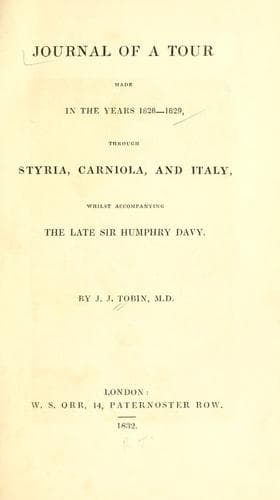
Journal of a Tour in the Years 1828-1829, through Styria, Carniola, and Italy, whilst Accompanying the Late Sir Humphry DavyTobin, J. J.
History
Journal of a Tour in the Years 1828-1829, through Styria, Carniola, and Italy, whilst Accompanying the Late Sir Humphry Davy
Tobin, J. J.
Davy, Humphry, Sir, 1778-1829; Europe -- Description and travel
_2nd._ The first _poste_ after leaving Courtrai was Vive St. Eloi,
an assemblage of a few shabby houses, hardly worthy the name of a
village; thence to Peteghen and to Ghent. The country is flat, and
anything but picturesque, and almost every field has a windmill in
it. We only stopped to dine at Ghent, and then immediately started
for Antwerp, where we arrived at about seven in the evening, passing
through Lakesen and St. Nicholas. We were ferried over the Scheldt, and
afterwards transported to the inn in a very novel manner. On arriving
at the ferry opposite the town, the post-horses were taken out of the
carriage, which was pushed into the ferry-boat by four men, who with
some difficulty dragged it out when on the other side of the river, and
then drew it with us in it through the town to the inn, more than half
a mile distant from the landing place. After tea I continued the "Bravo
of Venice," and read Voltaire's "Bababec et les Faquirs" to Sir Humphry.
_3rd._ We did not breakfast till late, and afterwards drove out to
see the town in spite of hail and snow. Our first visit was to the
cathedral, which much disappointed us both as to its internal and
external appearance. It strongly reminded me of that of Strasbourg,
which it resembles in its minuteness of architecture, and even in the
circumstance of its having its left tower in an unfinished state. The
right tower, which is complete, is neither so light, or airy, nor by
any means so beautifully sculptured as that of Strasbourg; nor does the
building, as a whole, bear any comparison with the latter in beauty and
effect. The interior is beautiful from its simplicity; and its having
been newly white-washed gave it a light and cheerful appearance. It
contains some fine pictures; the chief of which are the "Crucifixion,"
and the "Descent from the Cross," by Reubens. The pulpit, the largest
and most beautiful specimen of carved wood I ever saw, represents Adam
and Eve in the garden of Eden. We afterwards went into many of the
various churches, some of which are adorned with very fine paintings.
In that of St. Barbara are some very curious and beautifully carved
wooden confessionals, in a style similar to that of the pulpit in
the cathedral. Near this church is a celebrated Calvary,[A] which
also includes a representation of Purgatory and of Heaven, being an
assemblage of demons and saints in the most wretched taste. On one
side, through a grating, the mortal remains of our Saviour in the tomb
are presented to view; on the opposite side the Virgin Mary appears
decked out with flowers and gold lace, surrounded by a choir of angels
and saints; and on looking through a third grating one gets a peep
at purgatory, where the wicked are seen swimming about among waves
of flame in the strangest confusion imaginable. The whole of this
representation appeared to us most ridiculous; yet not so to many good
Catholics, whom we saw silently kneeling before the gratings, and
Public-domain text, read in full here on John Shaqi.
Reviews
Reviews
No reviews yet
Be the first to share your thoughts on this work.
Join the Discussion
Join the discussion
Sign in to leave a comment or review.
Sign InorCreate an account