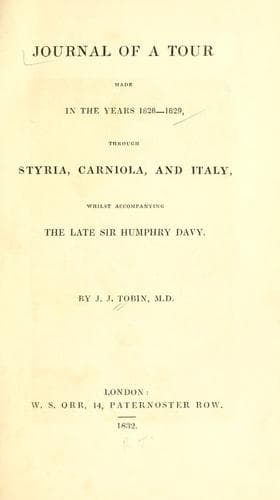
Journal of a Tour in the Years 1828-1829, through Styria, Carniola, and Italy, whilst Accompanying the Late Sir Humphry DavyTobin, J. J.
History
Journal of a Tour in the Years 1828-1829, through Styria, Carniola, and Italy, whilst Accompanying the Late Sir Humphry Davy
Tobin, J. J.
Davy, Humphry, Sir, 1778-1829; Europe -- Description and travel
_4th._ Left Antwerp in the morning, and passing through Coutegle,
Malines, or Mechlin, we arrived at Brussels about one o'clock. The road
runs nearly the whole of the way on the bank of a large canal, and is
often bordered by a row of fine beech trees. The appearance of this
capital from a distance is rather imposing; the handsomer and more
modern part of it being situated upon a hill, at the bottom of which
lies the old town, on the banks of the river Senne. The gate through
which we entered is remarkably handsome, and the style of architecture
light and elegant. We drove to the Hôtel de Flandres, on the Place
Royale, where we were very well accommodated. Before dinner I took a
hasty run through the town, just to see the fine old gothic town-house,
with its light and lofty spire, surmounted by a colossal statue of St.
Michael and the dragon, which acts as a vane; and the parks, palaces,
and fine public walks, which latter were crowded with English. English
equipages and servants are also continually passing in the streets;
and so many of the shops are completely English, that it is difficult
to believe that one is in the capital of a foreign nation. The number
of English generally in Brussels is said to exceed twenty thousand.
At one of the English circulating libraries I procured the "Legend of
Montrose," which amused Sir Humphry for the evening.
_5th._ At nine in the evening we left Brussels by the Porte de
Louvaine, and drove on to Tervueren, through a fine forest of beech
trees; at the extremity of which is situated the summer chateau of the
Prince of Orange, which, in external appearance, hardly equals the
country residence of an English gentleman. From thence we proceeded to
Louvaine, or Löwen; where we only stopped to change horses. The Hôtel
de Ville is one of the finest specimens of gothic architecture in the
Netherlands; but we could only catch a hasty view of it as we drove by
and went on to Thirlemont, where we dined, and after dinner proceeded
to St. Troud, which we made our resting-place for the night.
_6th._ We quitted St. Troud after breakfast, in the midst of rain and
snow, for Liege, or Lüttich, where we made no stay, but passed on to
Battices. Between this last place and Aix-la-Chapelle, we crossed the
boundary of the Netherlands, and entered upon the Prussian territory.
The custom-house officers were very civil; and Count Bülow's _besonders
empfohlen_, (particularly recommended), written in his own hand on Sir
Humphry's passport, was of great utility. We entered Aix-la-Chapelle in
the evening; and passing by the new theatre and the bath rooms, which
are pretty, but small buildings, we drove to the grand hotel, which was
neither grand nor comfortable. Our book for this evening was Swift's
"Tale of a Tub."
Public-domain text, read in full here on John Shaqi.
Reviews
Reviews
No reviews yet
Be the first to share your thoughts on this work.
Join the Discussion
Join the discussion
Sign in to leave a comment or review.
Sign InorCreate an account