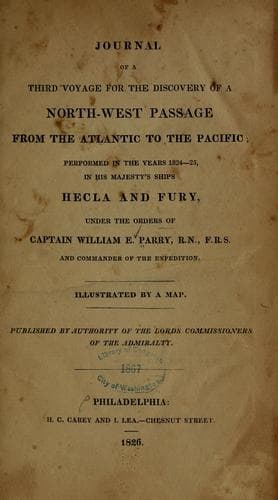
Journal of the Third Voyage for the Discovery of a North-West PassageParry, William Edward, Sir
History
Journal of the Third Voyage for the Discovery of a North-West Passage
Parry, William Edward, Sir
Arctic regions -- Discovery and exploration -- British; Fury (Ship); Hecla (Ship); Northwest Passage
This ebook was transcribed by Les Bowler.
CASSELL’S NATIONAL LIBRARY.
JOURNAL
OF THE
THIRD VOYAGE
FOR THE DISCOVERY OF A
NORTH-WEST PASSAGE.
BY
CAPT. W. E. PARRY, R.N., F.R.S.,
AND COMMANDER OF THE EXPEDITION.
CASSELL & COMPANY, LIMITED:
_LONDON_, _PARIS_, _NEW YORK & MELBOURNE_.
1889.
INTRODUCTION.
William Edward Parry, the son of a physician, was born at Bath in
December, 1790. At the age of thirteen he was entered as a first-class
volunteer on board the flag-ship of the Channel fleet, and after seven
years’ service and careful study of his profession he obtained a
commission in 1810 as lieutenant in the navy. He was then at once, aged
twenty, sent to the Arctic seas, where he was during two or three years
in command of a ship for protection of the British whale fisheries and
for revision of the admiralty charts. In 1813 he was recalled from that
service and sent on blockade service to the North American station, where
he remained about four years, and occupied his leisure in writing a book
on “Nautical Astronomy by Night,” which he published upon his return to
England in 1817.
At that time the search for a North-West Passage to Eastern Asia had been
suspended for more than half a century. No expedition had been sent out
since 1746. But after Lieutenant Parry’s return from the North American
station, an expedition was prepared under Sir John Ross in the
_Isabella_, which sailed in April, 1818, accompanied by the _Alexander_,
to the command of which Parry was appointed, Sir John Ross being chief of
the expedition. They went by Davis’s Straits to Lancaster Sound, where
Sir John Ross gave up hope of success and turned back; though Lieutenant
Parry would have gone on. Next year Parry was entrusted with an
expedition of his own, which set out in May, 1819, and reached Lancaster
Sound in July, discovered Prince Regent’s Inlet, and Barrow Straits,
named after Sir John Barrow, Secretary to the Admiralty, who was active
promoter of these expeditions. Parry wintered among the ice and returned
next year, having pushed Arctic discovery by thirty degrees of longitude
farther than any who had gone before. That was Parry’s first voyage,
from which he returned to be received with triumph by his countrymen. He
was advanced to the rank of Commander in November, 1820, and made a
Fellow of the Royal Society. He had shown in what direction to proceed
with further search, and at the age of thirty had established for himself
a place of lasting honour in the history of English navigation.
Public-domain text, read in full here on John Shaqi.
Reviews
Reviews
No reviews yet
Be the first to share your thoughts on this work.
Join the Discussion
Join the discussion
Sign in to leave a comment or review.
Sign InorCreate an account