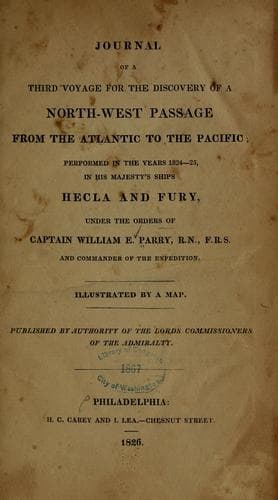
Journal of the Third Voyage for the Discovery of a North-West PassageParry, William Edward, Sir
History
Journal of the Third Voyage for the Discovery of a North-West Passage
Parry, William Edward, Sir
Arctic regions -- Discovery and exploration -- British; Fury (Ship); Hecla (Ship); Northwest Passage
We observed a great many narwhals in different parts of Barrow’s Strait,
and a few walruses, and should perhaps have seen many more of both, but
for the continual presence of the young ice.
CHAPTER III.
Winter Arrangements—Improvements in Warming and Ventilating the
Ships—Masquerades adopted as an Amusement to the Men—Establishment of
Schools—Astronomical Observations—Meteorological Phenomena.
_October_.—Our present winter arrangements so closely resembled, in
general, those before adopted, that a fresh description of them here
would prove little more than a repetition of that already contained in
the narratives of our former voyages. On each succeeding occasion,
however, some improvements were made which, for the benefit of those
hereafter engaged in similar enterprises, it may be proper to record.
For all those whose lot it may be to succeed us, sooner or later, in
these inhospitable regions, may be assured that it is only by rigid and
unremitted attention to these and numberless other “little things” that
they can hope to enjoy the good state of health which, under the Divine
blessing, it has always been our happiness, in so extraordinary a degree,
to experience.
In the description I shall offer of the appearances of nature, and of the
various occurrences, during this winter, I know not how I can do better
than pursue a method similar to that heretofore practised, by confining
myself rather to the pointing out of any difference observed in them now
and formerly, than by entering on a fresh description of the actual
phenomena. To those who read, as well as to those who describe, the
account of a winter passed in these regions can no longer be expected to
afford the interest of novelty it once possessed; more especially in a
station already delineated with tolerable geographical precision on our
maps, and thus, as it were, brought near to our firesides at home.
Independently, indeed, of this circumstance, it is hard to conceive any
one thing more like another than two winters passed in the higher
latitudes of the Polar regions, except when variety happens to be
afforded by intercourse with some other branch of “the whole family of
man.” Winter after winter, nature here assumes an aspect so much alike,
that cursory observation can scarcely detect a single feature of variety.
The winter of more temperate climates, and even in some of no slight
severity, is occasionally diversified by a thaw, which at once gives
variety and comparative cheerfulness to the prospect. But here, when
once the earth is covered, all is dreary, monotonous whiteness—not merely
for days or weeks, but for more than half a year together. Whichever way
the eye is turned, it meets a picture calculated to impress upon the mind
an idea of inanimate stillness, of that motionless torpor with which our
feelings have nothing congenial; of anything, in short, but life. In the
very silence there is a deadness with which a human spectator appears out
of keeping.
Public-domain text, read in full here on John Shaqi.
Reviews
Reviews
No reviews yet
Be the first to share your thoughts on this work.
Join the Discussion
Join the discussion
Sign in to leave a comment or review.
Sign InorCreate an account