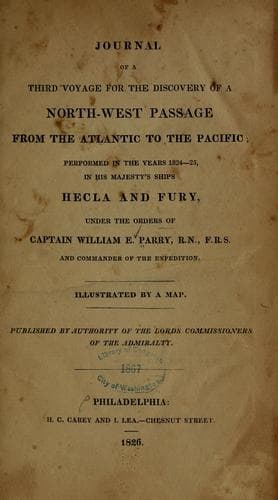
Journal of the Third Voyage for the Discovery of a North-West PassageParry, William Edward, Sir
History
Journal of the Third Voyage for the Discovery of a North-West Passage
Parry, William Edward, Sir
Arctic regions -- Discovery and exploration -- British; Fury (Ship); Hecla (Ship); Northwest Passage
further attempts at navigation: a risk not confined to the mere exposure
of the ships to imminent danger, or the hazard of being shut out of a
winter harbour, but to one which, I may be permitted to say, we all
dreaded as much as these—the too obvious probability of our once more
being driven back to the eastward, should we again become hampered in the
young ice. Joining to this the additional consideration that no known
place of security existed to the southward on this coast, I had not the
smallest hesitation in availing myself of the present opportunity to get
the ships into harbour. Beating up, therefore, to Port Bowen, we found
it filled with “old” and “hummocky” ice, attached to the shores on both
sides, as low down as about three-quarters of a mile below Stoney Island.
Here we made fast in sixty-two fathoms of water, running our hawsers far
in upon the ice, in case of its breaking off at the margin.
On entering Port Bowen, I was forcibly struck with the circumstance of
the cliffs on the south side of the harbour being, in many places,
covered with a layer of blue transparent-looking ice, occasioned
undoubtedly by the snow partially thawing there, and then being arrested
by the frost, and presenting a feature very indicative of the late cold
summer. The same thing was observed on all the land to which we made a
near approach on the south side of Barrow’s Strait this season,
especially about Cape York and Eardley Bay; but as we had never been
close to these parts of the shore in 1819, it did not occur to me as
anything new or worthy of notice. At Port Bowen, however, which in that
year was closely examined, I am quite certain that no such thing was to
be seen, even in the month of August, the cliffs being then quite clear
of snow, except here and there a patch of drift.
Late as we had this year been (about the middle of October) in reaching
Sir James Lancaster’s Sound, there would still have been time for a ship
engaged in a whale-fishery to have reaped a tolerable harvest, as we met
with a number of whales in every part of it, and even as far as the
entrance of Port Bowen. The number registered altogether in our journals
is between twenty and thirty, but I have no doubt that many more than
these were seen, and that a ship expressly on the look-out for them would
have found full occupation for her boats. Several which came near us
were of large and “payable” dimensions. I confess, however, that had I
been within the Sound, in a whaler, towards the close of so unfavourable
a season as this, with the young ice forming so rapidly on the whole
extent of the sea, I should not have been disposed to persevere in the
fishery under circumstances so precarious, and to a ship unprepared for a
winter involving such evident risk. It is probable, however, that on the
outside the formation of young ice would have been much retarded by the
swell; and I am inclined to believe that a season so unfavourable as this
will be found of rare occurrence.
Public-domain text, read in full here on John Shaqi.
Reviews
Reviews
No reviews yet
Be the first to share your thoughts on this work.
Join the Discussion
Join the discussion
Sign in to leave a comment or review.
Sign InorCreate an account