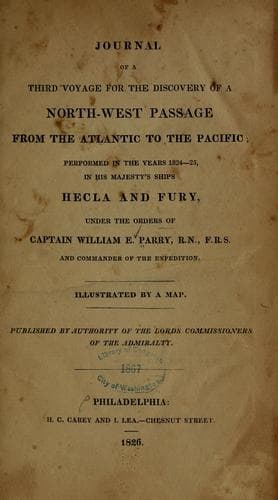
Journal of the Third Voyage for the Discovery of a North-West PassageParry, William Edward, Sir
History
Journal of the Third Voyage for the Discovery of a North-West Passage
Parry, William Edward, Sir
Arctic regions -- Discovery and exploration -- British; Fury (Ship); Hecla (Ship); Northwest Passage
The meteors called Falling-stars were much more frequent during this
winter than we ever before saw them, and particularly during the month of
December. On the 8th, at a quarter past seven in the evening, a
particularly large and brilliant meteor of this kind fell in the S.S.W.,
the weather being very fine and clear overhead, but hazy near the
horizon. On the following day, between four and five P.M., another very
brilliant one was observed in the north, falling from an altitude of
about thirty-five degrees till lost behind the land; the weather was at
this time clear and serene, and no remarkable change took place. On the
12th, no less than five meteors of this kind were observed in a quarter
of an hour, and as these were attended with some remarkable
circumstances, I shall here give the account furnished me by Mr. Ross,
who with Mr. Bell observed these phenomena. “From seven to nine P.M. the
wind suddenly increased from a moderate breeze to a strong gale from the
southward. At ten it began to moderate a little; the haze, which had for
several hours obscured every star, gradually sinking towards the horizon,
and by eleven o’clock the whole atmosphere was extremely clear above the
altitude of five or six degrees. The thermometer also fell from -5° to
-9° as the haze cleared away. At a quarter past eleven my attention was
directed by Mr. Bell to some meteors which he observed, and in less than
a quarter of an hour five were seen. The two first, noticed only by Mr.
Bell, fell in quick succession, probably not more than two minutes apart.
The third appeared about eight minutes after these, and exceeded in
brilliancy any of the surrounding stars. It took a direction from near β
Tauri, and passing slowly towards the Pleiades, left behind it sparks
like the tail of a rocket, these being visible for a few seconds after
the meteor appeared to break, which it did close to the Pleiades. The
fourth meteor made its appearance very near the same place as the last,
and about five minutes after it. Taking the course of those seen by Mr.
Bell, it passed to the eastward, and disappeared half way between β Tauri
and Gemini. The fifth of these meteors was seen to the eastward, passing
through a space of about five degrees from north to south parallel to the
horizon, and moving along the upper part of the cloud of haze which still
extended to the altitude of five or six degrees. It was more dim than
the rest, and of a red colour like Aldebaran. The third of these meteors
was the only one that left a tail behind it, as above described. There
was a faint appearance of the Aurora to the westward near the horizon.
Public-domain text, read in full here on John Shaqi.
Reviews
Reviews
No reviews yet
Be the first to share your thoughts on this work.
Join the Discussion
Join the discussion
Sign in to leave a comment or review.
Sign InorCreate an account