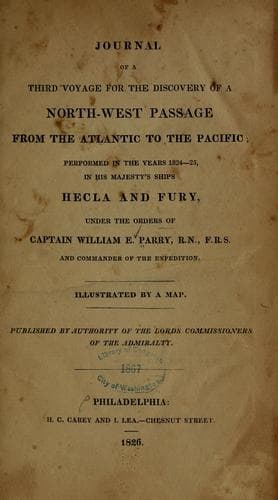
Journal of the Third Voyage for the Discovery of a North-West Passage — John Shaqi
Journal of the Third Voyage for the Discovery of a North-West PassageParry, William Edward, Sir
History
Journal of the Third Voyage for the Discovery of a North-West Passage
Parry, William Edward, Sir
Arctic regions -- Discovery and exploration -- British; Fury (Ship); Hecla (Ship); Northwest Passage
On the 14th of December several very bright meteors were observed to fall
between the hours of five and six in the evening, at which time the wind
freshened from the N.W. by N. in a very remarkable manner. On this
occasion, as well as on the 12th of December, there appeared to be an
evident coincidence between the occurrence of the meteors and the changes
of the weather at the time.
Particular attention was paid to the changes in the barometer during this
winter, to which much encouragement was given by the excellence of the
instruments with which we were now furnished. The times of register at
sea had been three and nine, A.M. and P.M.; those hours having been
recommended as the most proper for detecting any horary oscillations of
the mercurial column. When we were fixed for the winter, and our
attention could be more exclusively devoted to scientific objects, the
register was extended to four and ten, and subsequently to five and
eleven o’clock. The most rigid attention to the observation and
correction of the column, during several months, discovered an
oscillation amounting only to ten thousandth-parts of an inch. The times
of the maximum and minimum altitude appear, however, decidedly to lean to
four and ten o’clock, and to follow a law directly the reverse, as to
time, of that found to obtain in temperate climates, the column being
highest at four, and lowest at ten o’clock, both A.M. and P.M.
The barometer did not appear to indicate beforehand the changes of the
weather with any degree of certainty. Indeed the remark that we had
always before made, that alterations in the mercurial column more
frequently accompany than precede the visible changes of weather in these
regions, was equally true of our present experience; but on one or two
occasions hard gales of considerable duration occurred without the
barometer falling at all below the mean altitude of the column in these
regions, or even rose steadily during the continuance of the gale.
During one week of almost constant blowing weather, and two days of very
violent gales from the eastward, in the month of April, the barometer
remained considerably above thirty inches the whole time. It is
necessary for me here to remark that the unusual proportion of easterly
winds registered in our journals during this winter must, in my opinion,
be attributed to the local situation of our winter-quarters, which alone
appears to me sufficient to account for the anomaly. The lands on each
side of Port Bowen, running nearly east and west, and rising to a height
of six to nine hundred feet above the sea, with deep and broad ravines
intersecting the country in almost every direction, may be supposed to
have had considerable influence on the direction of the wind. In
confirmation of this supposition, indeed, it was usually noticed that the
easterly winds were with us attended with clear weather, while the
contrary obtained with almost every breeze from the west and north-west,
Public-domain text, read in full here on John Shaqi.
Reviews
Reviews
No reviews yet
Be the first to share your thoughts on this work.
Join the Discussion
Join the discussion
Sign in to leave a comment or review.
Sign InorCreate an account