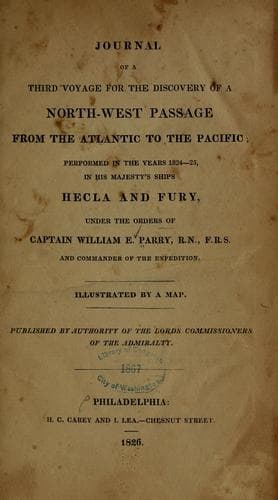
Journal of the Third Voyage for the Discovery of a North-West PassageParry, William Edward, Sir
History
Journal of the Third Voyage for the Discovery of a North-West Passage
Parry, William Edward, Sir
Arctic regions -- Discovery and exploration -- British; Fury (Ship); Hecla (Ship); Northwest Passage
Lieutenant Ross, who paid great attention to ornithology, remarked that
the grouse met with here are of three kinds, namely, the ptarmigan
(_Tetrao Lagopus_), the rock-grouse, (_Tetrao Rupestris_), and the
willow-partridge (_Tetrao Albus_). Of these only the two former were
seen in the spring, and by far the greater number killed were of the
first-mentioned species. They usually had in their maws the leaves of
the _Dryas Integrifolia_, buds of the _Saxifraga Oppositifolia_, _Salix
Arctica_, and _Draba Alpina_, the quantities being according to the order
in which the plants have here been named. A few leaves also of the
_Polygonum Viviparum_ were found in one or two specimens. The
snow-bunting, with its sprightly note, was, as usual, one of our earliest
visitants in the spring; but these were few in number and remained only a
short time. A very few sand-pipers were also seen, and now and then one
or two glaucous, ivory, and kittiwake gulls. A pair of ravens appeared
occasionally during the whole winter here, as at most of our former
winter stations.
With a view to extend our geographical knowledge as much as our means
permitted, three land journeys were undertaken as soon as the weather was
sufficiently warm for procuring any water. The first party, consisting
of six men, under Captain Hoppner, were instructed to travel to the
eastward, to endeavour to reach the sea in that direction and to discover
the communication which probably exists there with Admiralty Inlet, so as
to determine the extent of that portion of insular land on which Port
Bowen is situated. They returned on the 14th, after a very fatiguing
journey, and having with difficulty travelled a degree and three-quarters
to the eastward of the ships, in latitude 73° 19′, from which position no
appearance of the sea could be perceived. Captain Hoppner described the
ravines as extremely difficult to pass, many of them being four or five
hundred feet deep and very precipitous. These being numerous and running
chiefly in a north and south direction, appearing to empty themselves
into Jackson’s Inlet, preclude the possibility of performing a quick
journey to the eastward. During the whole fortnight’s excursion scarcely
a patch of vegetation could be seen. Indeed, the hills were so covered
in most parts with soft and deep snow that a spot could seldom be found
on which to pitch their tent. A few snow-buntings and some ivory gulls
were all the animals they met with to enliven this most barren and
desolate country; and nothing was observed in the geological character
differing from that about Port Bowen.
In the bed of one of the ravines Captain Hoppner noticed some immense
masses of rock, thirty or forty tons in weight, which had recently fallen
from above, and he also passed over several avalanches of snow piled to a
vast height across it.
Public-domain text, read in full here on John Shaqi.
Reviews
Reviews
No reviews yet
Be the first to share your thoughts on this work.
Join the Discussion
Join the discussion
Sign in to leave a comment or review.
Sign InorCreate an account