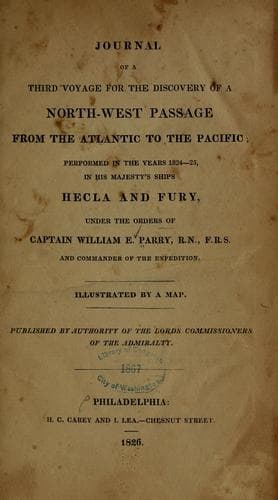
Journal of the Third Voyage for the Discovery of a North-West PassageParry, William Edward, Sir
History
Journal of the Third Voyage for the Discovery of a North-West Passage
Parry, William Edward, Sir
Arctic regions -- Discovery and exploration -- British; Fury (Ship); Hecla (Ship); Northwest Passage
A she-bear, killed in the open water on our first arrival at Port Bowen,
afforded a striking instance of maternal affection in her anxiety to save
her two cubs. She might herself easily have escaped the boat, but would
not forsake her young, which she was actually “towing” off by allowing
them to rest on her back, when the boat came near them. A second similar
instance occurred in the spring, when two cubs having got down into a
large crack in the ice their mother placed herself before them, so as to
secure them from the attacks of our people, which she might easily have
avoided herself.
This unusual supply of bear’s flesh was particularly serviceable as food
for the Esquimaux dogs we had brought out, and which were always at work
in a sledge; especially as, during the winter, our number was increased
by the birth of six others of these useful animals.
One or two foxes (_Canis Lagopus_) were killed, and four caught in traps
during the winter, weighing from four pounds and three-quarters to three
pounds and three-quarters. The colour of one of these animals, which
lived for some time on board the _Fury_ and became tolerably tame, was
nearly pure white till the month of May, when he shed his winter-coat and
became of a dirty chocolate colour, with two or three light brown spots.
Only three hares (_Lepus Variabilis_) were killed from October to June,
weighing from six to eight pounds and three-quarters. Their fur was
extremely thick, soft, and of the most beautiful whiteness imaginable.
We saw no deer near Port Bowen at any season, neither were we visited by
their enemies the wolves. A single ermine and a few mice (_Mus
Hudsonius_) complete, I believe, our scanty list of quadrupeds at this
desolate and unproductive place.
Of birds, we had a flock or two of ducks occasionally flying about the
small lanes of open water in the offing, as late as the 3rd of October;
but none from that time to the beginning of June, and then only a single
pair was occasionally seen. A very few grouse were met with also after
our arrival at Port Bowen; a single specimen was obtained on the 23rd of
December, and another on the 18th of February. They again made their
appearance towards the end of March, and in less than a month about two
hundred were killed; after which we scarcely saw another, for what reason
we could not conjecture, except that they might possibly be on their way
to the northward, and that the utter barrenness of the land about Port
Bowen afforded no inducement for their remaining in our neighbourhood.
Public-domain text, read in full here on John Shaqi.
Reviews
Reviews
No reviews yet
Be the first to share your thoughts on this work.
Join the Discussion
Join the discussion
Sign in to leave a comment or review.
Sign InorCreate an account