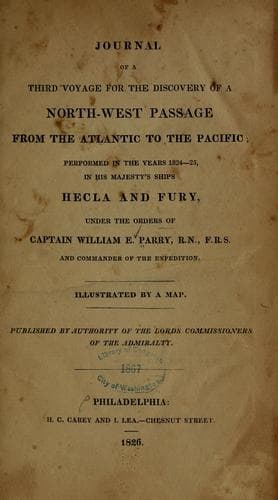
Journal of the Third Voyage for the Discovery of a North-West PassageParry, William Edward, Sir
History
Journal of the Third Voyage for the Discovery of a North-West Passage
Parry, William Edward, Sir
Arctic regions -- Discovery and exploration -- British; Fury (Ship); Hecla (Ship); Northwest Passage
We had now an opportunity of discovering that a long neck of very low
land runs out from the southernmost of the Leopold Islands, and another
from the shore to the southward of Cape Clarence. These two had every
appearance of joining, so as to make a peninsula, instead of an island,
of that portion of land which, on account of our distance preventing our
seeing the low beach, had in 1819 been considered under the latter
character. It is, however, still somewhat doubtful, and the Leopold
Isles, therefore, still retain their original designation on the chart.
The land here, when closely viewed, assumes a very striking and
magnificent character, the strata of limestone, which are numerous and
quite horizontally disposed, being much more regular than on the eastern
shore of Prince Regent’s Inlet, and retaining nearly their whole
perpendicular height of six or seven hundred feet, close to the sea. The
south-eastern promontory of the southernmost island is particularly
picturesque and beautiful, the heaps of loose _débris_ lying here and
there up and down the sides of the cliff giving it the appearance of some
huge and impregnable fortress, with immense buttresses of masonry
supporting the walls. Near Cape Seppings, and some distance beyond it to
the southward, we noticed a narrow stratum of some very white substance,
the nature of which we could not at this time conjecture. I may here
remark that the whole of Barrow’s Strait, as far as we could see to the
N.N.E. of the islands, was entirely free from ice; and from whatever
circumstance it may proceed, I do not think that this part of the Polar
Sea is at any season very much encumbered with it.
It was the general feeling, at this period, among us, that the voyage had
but now commenced. The labours of a bad summer, and the tedium of a long
winter, were forgotten in a moment when we found ourselves upon ground
not hitherto explored, and with every apparent prospect before us of
making as rapid a progress as the nature of this navigation will permit
towards the final accomplishment of our object.
Public-domain text, read in full here on John Shaqi.
Reviews
Reviews
No reviews yet
Be the first to share your thoughts on this work.
Join the Discussion
Join the discussion
Sign in to leave a comment or review.
Sign InorCreate an account