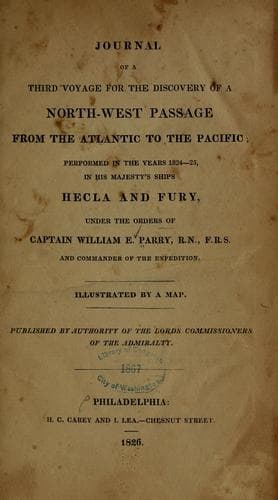
Journal of the Third Voyage for the Discovery of a North-West Passage — John Shaqi
Journal of the Third Voyage for the Discovery of a North-West PassageParry, William Edward, Sir
History
Journal of the Third Voyage for the Discovery of a North-West Passage
Parry, William Edward, Sir
Arctic regions -- Discovery and exploration -- British; Fury (Ship); Hecla (Ship); Northwest Passage
Early on the morning of the 25th, we passed the opening in the land
delineated in the former chart of this coast, in latitude 73° 34′, which
we now found to be a bay about three miles deep, but apparently open to
the sea. I named it after my friend, Hastings Elwin, Esq., of Bristol,
as a token of grateful esteem for that gentleman. The wind falling very
light, so that the ships made no progress, I took the opportunity of
landing in the fore-noon, accompanied by a party of the officers, and was
soon after joined by Captain Hoppner. We found the formation to consist
wholly of lime, and now discovered the nature of the narrow white stratum
observed the day before from the offing, and which proved to be gypsum,
mostly of the earthy kind, and some of it of a very pure white. A part
of the rock near our landing-place contained a quantity of it in the
state of selenite in beautiful transparent laminæ of a large size. The
abundance of gypsum hereabouts explained also the extreme whiteness of
the water near the whole of this part of the coast, which had always been
observed in approaching it, and which had at first excited unnecessary
apprehensions as to the soundings along the shore. This colour is more
particularly seen near the mouths of the streams, many of which are quite
of a dirty milk colour, and tinge the sea to the distance of more than a
mile, without any alteration in the depth, except a gradual diminution in
going in. The vegetation in this place was, as usual, extremely scanty,
though much more luxuriant than on any of the land near our winter
quarters, and no animals were seen. The latitude of our landing-place
was 73° 27′ 23″, the longitude by chronometers 90° 50′ 34.6″, and the
variation of the magnetic needle 125° 34′ 42″ westerly. From half-past
nine A.M. till a quarter past noon the tide fell two feet three inches;
and as it was nearly stationary at the latter time, it was probably near
low water.
Public-domain text, read in full here on John Shaqi.
Reviews
Reviews
No reviews yet
Be the first to share your thoughts on this work.
Join the Discussion
Join the discussion
Sign in to leave a comment or review.
Sign InorCreate an account