Journal of the Third Voyage for the Discovery of a North-West Passage — John Shaqi
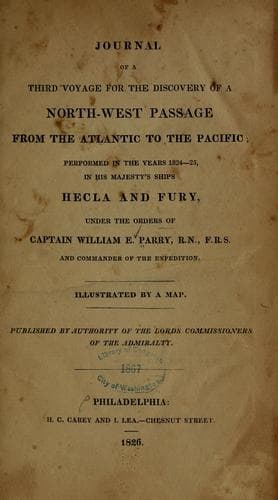
Journal of the Third Voyage for the Discovery of a North-West PassageParry, William Edward, Sir
History
Journal of the Third Voyage for the Discovery of a North-West Passage
Parry, William Edward, Sir
Arctic regions -- Discovery and exploration -- British; Fury (Ship); Hecla (Ship); Northwest Passage
A breeze enabling us again to make some progress, and an open channel
still favouring us of nearly the same breadth as before, we passed during
the night a second bay, about the same size as the other, and also
appearing open to the sea; it lies in latitude (by account from the
preceding and following noon) 73° 19′ 30″, and its width is one mile and
a half. It was called Batty Bay, after my friend Captain Robert Batty,
of the Grenadier Guards. We now perceived that the ice closed completely
in with the land a short distance beyond us, and having made all the way
we could, were obliged to stand off and on during the day in a channel
not three-quarters of a mile wide. This channel being still more
contracted towards the evening, we were obliged to make fast to some
grounded land ice upon the beach in four fathoms water, there to await
some change in our favour. We here observed traces of our old friends
the Esquimaux, there being several of their circles of stones, though not
of recent date, close to the sea. We also found a more abundant
vegetation than before, and several plants familiar to us on the former
voyages, but not yet procured on this, were now added to our collections.
The geological character of the land was nearly the same as before, but
we found here some gypsum of the fibrous kind, occurring in a single
stratum about an inch and a half wide. About a mile to the north of us
was a curious cascade or spout of water, issuing from a chasm in the
rock, and falling more than two hundred feet perpendicular. Our
gentlemen, who visited the spot, described it as rendered the more
picturesque by innumerable kittiwakes having their nests among the rocks,
and constantly flying about the stream. The latitude was 73° 06′ 17″,
the longitude by chronometers 91° 19′ 52.3″, the dip of the magnetic
needle 88° 02.1′, and the variation 128° 23′ 17″ westerly.
The ice opening in the afternoon of the 27th, we cast off and run four or
five miles with a northerly breeze. This wind, however, always had the
effect of making the ice close the shore, while a southerly breeze as
uniformly opened it, so that on this coast, as on several others that I
have known, a contrary wind—however great the paradox may seem—proved, on
the whole, the most favourable for making progress. This circumstance is
simply to be attributed to the greater abundance of open water in the
parts we have left behind (in the present instance the open sea of
Barrow’s Strait) than those towards which we are going. We were once
more obliged to make fast, therefore, to some grounded ice close to the
beach, rather than run any risk of hampering the ships, and rendering
them unable to take advantage of a change in our favour.
Public-domain text, read in full here on John Shaqi.
Reviews
Reviews
No reviews yet
Be the first to share your thoughts on this work.
Join the Discussion
Join the discussion
Sign in to leave a comment or review.
Sign InorCreate an account