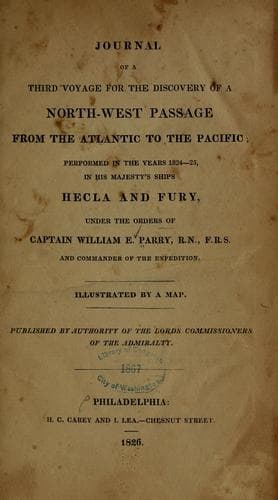
Journal of the Third Voyage for the Discovery of a North-West Passage — John Shaqi
Journal of the Third Voyage for the Discovery of a North-West PassageParry, William Edward, Sir
History
Journal of the Third Voyage for the Discovery of a North-West Passage
Parry, William Edward, Sir
Arctic regions -- Discovery and exploration -- British; Fury (Ship); Hecla (Ship); Northwest Passage
On the 29th, the ice being slack for a short distance, we shifted the
_Hecla_ half a mile to the northward, into a less insecure berth. I then
walked to a broad valley facing the sea near us, where a considerable
stream discharged itself, and where, in passing in the ships, a large
fish had been observed to jump out of the water. In hopes of finding
salmon here, we tried for some time with several hand-nets, but nothing
was caught or seen. In this place were a number of the Esquimaux stone
circles, apparently of very old date, being quite overgrown with grass,
moss, and other plants. In the neighbourhood of these habitations the
vegetation was much more luxuriant than anything of the kind we had seen
before during this voyage. The state of this year’s plants was now very
striking, compared with those of the last, and afforded strong evidence,
if any had been wanting, of the difference between the two seasons. I
was particularly struck with the appearance of some moss collected by Mr.
Hooper, who pointed out to me upon the same specimen the last year’s
miserable seeds just peeping above the leaves, while those of the present
summer had already shot three-quarters of an inch beyond them. Another
circumstance which we noticed about this time, and still more so as the
season advanced, was the rapid progress which the warmth had already made
in dissolving the last year’s snow, this being always easily known by its
dingy colour, and its admixture with the soil. Of the past winter’s snow
not a particle could be seen at the close of July on any part of this
coast. These facts, together with the beautiful weather we had enjoyed
for many weeks past, all tended to show that we were now favoured with an
unusually fine summer. We found in this place, in the dry bed of an old
stream, innumerable fossils in the limestone, principally shells and
madrepore. On a hill abreast of the _Hecla_, and at an elevation of not
less than three or four hundred feet above the sea, one particular spot
was discovered in which the same kind of shells first found in Barrow’s
Strait in 1819 occurred in very great abundance and perfection, wholly
detached from the lime in which for the most part they were found
embedded in other places on this coast. Indeed, it was quite
astonishing, in looking at the numberless fossil animal remains occurring
in many of the stones, to consider the countless myriads of shell fish
and marine insects which must once have existed on this shore. The
cliffs next the sea, which here rise to a perpendicular height of between
four and five hundred feet, were continually breaking down at this
season, and adding, by falls of large masses of stone, to the slope of
_débris_ lying at their foot. The ships lay so close to the shore as to
be almost within the range of some of these tumbling masses, there being
at high water scarcely beach enough for a person to walk along the shore.
Public-domain text, read in full here on John Shaqi.
Reviews
Reviews
No reviews yet
Be the first to share your thoughts on this work.
Join the Discussion
Join the discussion
Sign in to leave a comment or review.
Sign InorCreate an account