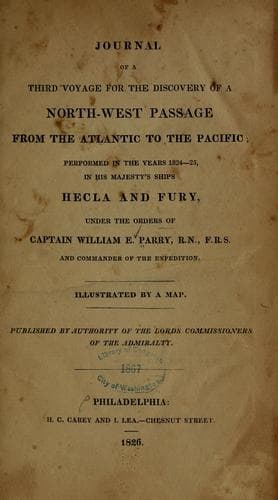
Journal of the Third Voyage for the Discovery of a North-West PassageParry, William Edward, Sir
History
Journal of the Third Voyage for the Discovery of a North-West Passage
Parry, William Edward, Sir
Arctic regions -- Discovery and exploration -- British; Fury (Ship); Hecla (Ship); Northwest Passage
We have scarcely ever visited a coast on which so little of animal life
occurs. For days together, only one or two seals, a single sea-horse,
and now and then a flock of ducks, were seen. I have already mentioned,
however, as an exception to this scarcity of animals, the numberless
kittiwakes which were flying about the remarkable spout of water; and we
were one day visited, at the place where the _Fury_ was left, by hundreds
of white whales sporting about in the shoal water close to the beach. No
black whales were ever seen on this coast. Two reindeer were observed by
the gentlemen who extended their walks inland; but this was the only
summer in which we did not procure a single pound of venison. Indeed,
the whole of our supplies obtained in this way during the voyage,
including fish, flesh, and fowl, did not exceed twenty pounds per man.
During the time that we were made fast upon this coast, in which
situation alone observations on current can be satisfactorily made, it is
certain that the ice was setting to the southward, and sometimes at a
rapid rate, full seven days out of every ten on an average. Had I now
witnessed this for the first time in these seas, I should probably have
concluded that there was a constant southerly set at this season; but the
experience we had before obtained of that superficial current which every
breeze of wind creates in a sea encumbered with ice, coupled with the
fact that while this set was noticed we had an almost continual
prevalence of northerly winds, inclines me to believe that it was to be
attributed—chiefly at least—to this circumstance, especially as, on one
or two occasions, with rather a light breeze from the southward, the ice
did set slowly in the opposite direction. It is not by a few unconnected
observations that a question of this kind is to be settled, as the facts
noticed during our detention near the west end of Melville Island in 1820
will abundantly testify; every light air of wind producing, in half an
hour’s time, an extraordinary change of current setting at an incredible
rate along the land.
Public-domain text, read in full here on John Shaqi.
Reviews
Reviews
No reviews yet
Be the first to share your thoughts on this work.
Elsewhere in the archive
Join the Discussion
Join the discussion
Sign in to leave a comment or review.
Sign InorCreate an account