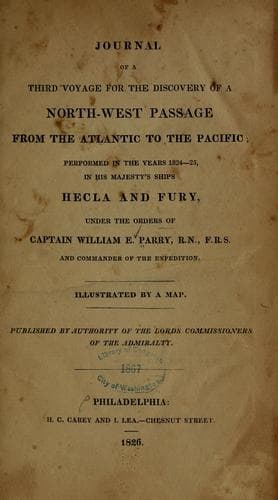
Journal of the Third Voyage for the Discovery of a North-West PassageParry, William Edward, Sir
History
Journal of the Third Voyage for the Discovery of a North-West Passage
Parry, William Edward, Sir
Arctic regions -- Discovery and exploration -- British; Fury (Ship); Hecla (Ship); Northwest Passage
The wind heading us from the eastward on the 2nd, with fog and wet
weather, obliged us to stretch across the Sound, in doing which we had
occasion to remark the more than usual number of icebergs that occurred
in this place, which was abreast of Navy Board Inlet. Many of these were
large and of the long flat kind, which appear to me to be peculiar to the
western coast of Baffin’s Bay. I have no doubt that this more than usual
quantity of icebergs in Sir James Lancaster’s Sound was to be attributed
to the extraordinary prevalence and strength of the easterly winds during
this summer, which would drive them from the eastern parts of Baffin’s
Bay. They now occurred in the proportion of at least four for one that
we had ever before observed here.
Being again favoured with a fair wind, we now stretched to the eastward,
still in an open sea; and our curiosity was particularly excited to see
the present situation of the ice in the middle of Baffin’s Bay, and to
compare it with that in 1824. This comparison we were enabled to make
the more fairly, because the season at which we might expect to come to
it coincided, within three or four days, with that in which we left it
the preceding year. The temperature of the sea-water now increased to
38°, soon after leaving the Sound, where it had generally been from 33°
to 35°, whereas at the same season last year it rose no higher than 32°
anywhere in the neighbourhood, and remained even so high as that only for
a very short time. This circumstance seemed to indicate the total
absence of ice from those parts of the sea which had last autumn been
wholly covered by it. Accordingly, on the 5th, being thirty miles beyond
the spot in which we had before contended with numerous difficulties from
ice, not a piece was to be seen, except one or two solitary bergs; and it
was not till the following day, in latitude 72° 45′, and longitude 64°
44′, or about one hundred and twenty-seven miles to the eastward of where
we made our escape on the 9th of September, 1824, that we fell in with a
body of ice so loose and open as scarcely to oblige us to alter our
course for it. At three P.M. on the 7th, being in latitude 72° 30′, and
longitude 60° 05′, and having, in the course of eighty miles that we had
run through it, only made a single tack, we came to the margin of the
ice, and got into an open sea on its eastern side. In the whole course
of this distance the ice was so much spread, that it would not, if at all
closely “packed,” have occupied one-third of the same space. There were
at this time thirty-nine bergs in sight, and some of them certainly not
less than two hundred feet in height.
Public-domain text, read in full here on John Shaqi.
Reviews
Reviews
No reviews yet
Be the first to share your thoughts on this work.
Elsewhere in the archive
Join the Discussion
Join the discussion
Sign in to leave a comment or review.
Sign InorCreate an account