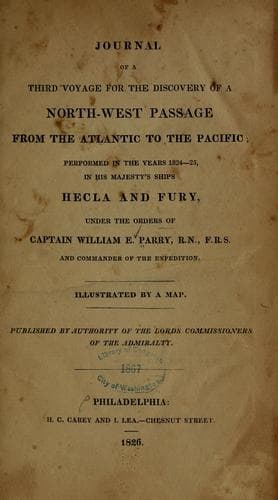
Journal of the Third Voyage for the Discovery of a North-West PassageParry, William Edward, Sir
History
Journal of the Third Voyage for the Discovery of a North-West Passage
Parry, William Edward, Sir
Arctic regions -- Discovery and exploration -- British; Fury (Ship); Hecla (Ship); Northwest Passage
The narrowness and openness of the ice at this season, between the
parallels of 73° and 74°, when compared with its extent and closeness
about the same time the preceding year, was a decided confirmation, if
any were wanting, that the summer of 1824 was extremely unfavourable for
penetrating to the westward about the usual latitudes. How it had proved
elsewhere we could not of course conjecture, till, on the 8th, being in
latitude 71° 55′, longitude 60° 30′, and close to the margin of the ice,
we fell in with the _Alfred_, _Ellison_, and _Elizabeth_, whalers of
Hull, all running to the northward, even at this season, to look for
whales. From them we learned that the _Ellison_ was one of the two ships
we saw, when beset in the “pack” on the 18th July, 1824; and that they
were then, as we had conjectured, on their return from the northward, in
consequence of having failed in effecting a passage to the westward. The
master of the _Ellison_ informed us that, after continuing their course
along the margin of the ice to the southward, they at length passed
through it to the western land without any difficulty, in the latitude of
68° to 69°. Many other ships had also crossed about the same parallels,
even in three or four days; but none, it seemed, had succeeded in doing
so, as usual, to the northward. Thus it plainly appeared (and I need not
hesitate to confess that to me the information was satisfactory) that our
bad success in pushing across the ice in Baffin’s Bay in 1824, had been
caused by circumstances neither to be foreseen nor controlled; namely, by
a particular position of the ice, which, according to the best
information I have been able to collect, has never before occurred during
the only six years that it has been customary for the whalers to cross
this ice at all, and which, therefore, in all probability, will seldom
occur again.
If we seek for a cause for the ice thus hanging with more than ordinary
tenacity to the northward, the comparative coldness of the season
indicated by our meteorological observations may perhaps be considered
sufficient to furnish it. For as the annual clearing of the northern
parts of Baffin’s Bay depends entirely on the time of the disruption of
the ice, and the rate at which it is afterwards drifted to the southward
by the excess of northerly winds, any circumstance tending to retain it
in the bays and inlets to a later period than usual, and subsequently to
hold it together in large floes, which drive more slowly than smaller
masses, would undoubtedly produce the effect in question. There is, at
all events, one useful practical inference to be drawn from what has been
stated, which is that, though perhaps in a considerable majority of years
a northern latitude may prove the most favourable for crossing in, yet
seasons will sometimes intervene in which it will be a matter of great
uncertainty whereabouts to make the attempt with the best hope of
success.
Public-domain text, read in full here on John Shaqi.
Reviews
Reviews
No reviews yet
Be the first to share your thoughts on this work.
Elsewhere in the archive
Join the Discussion
Join the discussion
Sign in to leave a comment or review.
Sign InorCreate an account