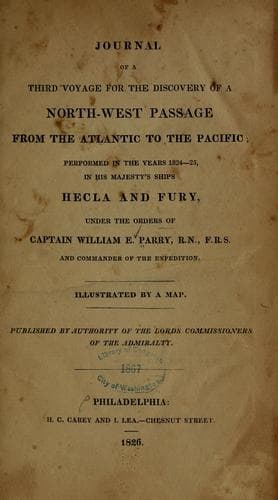
Journal of the Third Voyage for the Discovery of a North-West PassageParry, William Edward, Sir
History
Journal of the Third Voyage for the Discovery of a North-West Passage
Parry, William Edward, Sir
Arctic regions -- Discovery and exploration -- British; Fury (Ship); Hecla (Ship); Northwest Passage
With respect to the dimensions of the ice through which we had now
scrambled our way, principally by warping and towing a distance of
between three and four hundred miles, I remarked that it for the most
part increased, as well in the thickness as the extent of the floes, as
we advanced westward about the parallel of 71°. During our subsequent
progress to the north, we also met with some of enormous dimensions,
several of the floes, to which we applied our hawsers and the power of
the improved capstan, being at their margin more than twenty feet above
the level of the sea, and over some of these we could not see from the
mast-head. Upon the whole, however, the magnitude of the ice became
somewhat less towards the north-west; and within thirty miles of that
margin the masses were comparatively small, and their thickness much
diminished. Bergs were in sight during the whole passage; but they were
more numerous towards the middle of the “pack,” and rather the most so to
the southward.
CHAPTER II.
Enter Sir James Lancaster’s Sound—Land at Cape Warrender—Meet with young
ice—Ships beset and carried near the shore—Driven back to Navy-board
Inlet—Run to the westward, and enter Prince Regent’s Inlet—Arrival at
Port Bowen.
All our past obstacles were in a moment forgotten when we once more saw
an open sea before us; but it must be confessed that it was not so easy
to forget that the middle of September was already near at hand, without
having brought us even to the entrance of Sir James Lancaster’s Sound.
That not a moment might be lost, however, in pushing to the westward, a
press of canvas was crowded, and being happily favoured with an easterly
breeze, on the morning of the 10th of September we caught a glimpse of
the high bold land on the north side of the magnificent inlet up which
our course was once more to be directed. From the time of our leaving
the main body of ice we met with none of any kind, and the entrance to
the Sound was, as usual, entirely free from it, except here and there a
berg, floating about in that solitary grandeur of which these enormous
masses, when occurring in the midst of an extensive sea, are calculated
to convey so sublime an idea.
On the morning of the 11th, the ships being taken a-back with a fresh
westerly breeze when near Cape Warrender, I landed in a small bay close
to the westward of it, accompanied by several of the officers, in order
to examine the country, and to make the necessary observations.
Public-domain text, read in full here on John Shaqi.
Reviews
Reviews
No reviews yet
Be the first to share your thoughts on this work.
Join the Discussion
Join the discussion
Sign in to leave a comment or review.
Sign InorCreate an account