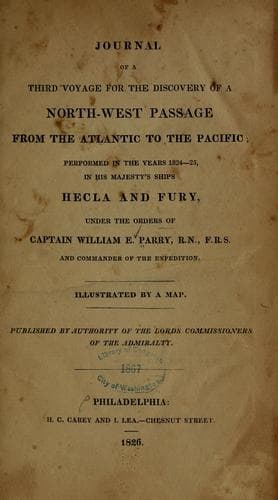
Journal of the Third Voyage for the Discovery of a North-West Passage — John Shaqi
Journal of the Third Voyage for the Discovery of a North-West PassageParry, William Edward, Sir
History
Journal of the Third Voyage for the Discovery of a North-West Passage
Parry, William Edward, Sir
Arctic regions -- Discovery and exploration -- British; Fury (Ship); Hecla (Ship); Northwest Passage
_Sept. 9th_.—I shall doubtless be readily excused for not having entered
in this journal a detailed narrative of the obstacles we met with, and of
the unwearied exertions of the officers and men to overcome them, during
the tedious eight weeks employed in crossing this barrier. I have
avoided this detail because, while it might appear an endeavour to
magnify ordinary difficulties, which it is our business to overcome
rather than to discuss, I am convinced that no description of mine, nor
even the minute formality of the log-book, could convey an adequate idea
of the truth. The strain we constantly had occasion to heave on the
hawsers, as springs to force the ships through the ice, was such as
perhaps no ships ever before attempted; and by means of Phillips’s
invaluable capstan, we often separated floes of such magnitude as must
otherwise have baffled every effort. In doing this, it was next to
impossible to avoid exposing the men to very great risk from the frequent
breaking of the hawsers. On one occasion, three of the _Hecla’s_ seamen
were knocked down as instantaneously as by a gunshot by the sudden
flying-out of an anchor; and a marine of the _Fury_ suffered in a similar
manner when working at the capstan; but, providentially, they all escaped
with severe contusions. A more serious accident occurred in the breaking
of the spindle of the _Fury’s_ windlass, depriving her of the use of the
windlass-end during the rest of the season.
The constant besetment of the ships, and our daily observations for
latitude and longitude, afforded a favourable opportunity for
ascertaining precisely the set of any currents by which the whole body of
ice might be actuated. By attending very carefully to all the
circumstances, it was evident that a daily set to the southward obtained,
when the wind was northerly, differing in amount from two or three to
eight or ten miles per day, according to the strength of the breeze; but
a northerly current was equally apparent, and fully to the same amount,
whenever the wind blew from the southward. A circumstance more
remarkable than these, however, forced itself strongly upon my notice at
this time, which was, that a _westerly_ set was very frequently apparent,
even against a fresh breeze blowing from that quarter. I mention the
circumstance in this place, because I may hereafter have to offer a
remark or two on this fact in connection with some others of a similar
nature noticed elsewhere.
Public-domain text, read in full here on John Shaqi.
Reviews
Reviews
No reviews yet
Be the first to share your thoughts on this work.
Join the Discussion
Join the discussion
Sign in to leave a comment or review.
Sign InorCreate an account