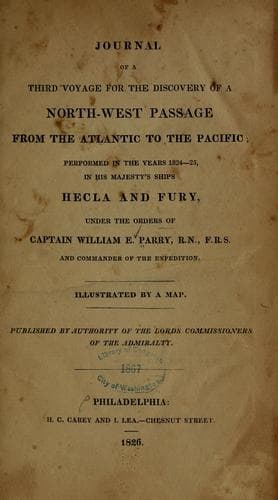
Journal of the Third Voyage for the Discovery of a North-West PassageParry, William Edward, Sir
History
Journal of the Third Voyage for the Discovery of a North-West Passage
Parry, William Edward, Sir
Arctic regions -- Discovery and exploration -- British; Fury (Ship); Hecla (Ship); Northwest Passage
who are less nice dispose their hair into a loose plait on each side, or
have one _tŏglēēgă_ and one plait; and others again, wholly disregarding
the business of the toilet, merely tucked their hair in under the breast
of their jackets. Some of the women’s hair was tolerably fine, but would
not in this respect bear a comparison with that of an Englishwoman. In
both sexes it is full of vermin, which they are in the constant habit of
picking out and eating; a man and his wife will sit for an hour together
performing for each other that friendly office. The women have a comb,
which, however, seems more intended for ornament than use, as we seldom
or never observed them comb their hair. When a woman’s husband is ill
she wears her hair loose, and cuts it off as a sign of mourning if he
dies—a custom agreeing with that of the Greenlanders. It is probable
also, from what has been before said, that some opprobrium is attached to
the loss of a woman’s hair when no such occasion demands this sacrifice.
The men wear the hair on the upper lip and chin, from an inch to an inch
and a half in length, and some were distinguished by a little tuft
between the chin and lower lip.
The dresses both of male and female are composed almost entirely of
deer-skin, in which respect they differ from those of most Esquimaux
before met with. In the form of the dress they vary very little from
those so repeatedly described. The jacket, which is close, but not
tight, all round, comes as low as the hips, and has sleeves reaching to
the wrist. In that of the women, the tail or flap behind is very broad,
and so long as almost to touch the ground; while a shorter and narrower
one before reaches half-way down the thigh. The men have also a tail in
the hind part of their jacket, but of smaller dimensions; but before it
is generally straight or ornamented by a single scollop. The hood of the
jacket, which forms the only covering for their head, is much the largest
in that of the women, for the purpose of holding a child. The back of
the jacket also bulges out in the middle to give the child a footing, and
a strap or girdle below this, and secured round the waist by two large
wooden buttons in front, prevents the infant from falling through, when,
the hood being in use, it is necessary thus to deposit it. The sleeves
of the women’s jackets are made more square and loose about the shoulders
than those of the men, for the convenience, as we understood, of more
readily depositing a child in the hood; and they have a habit of slipping
their arms out of them, and keeping them in contact with their bodies for
the sake of warmth, just as we do with our fingers in our gloves in very
cold weather.
Public-domain text, read in full here on John Shaqi.
Reviews
Reviews
No reviews yet
Be the first to share your thoughts on this work.
Elsewhere in the archive
Join the Discussion
Join the discussion
Sign in to leave a comment or review.
Sign InorCreate an account