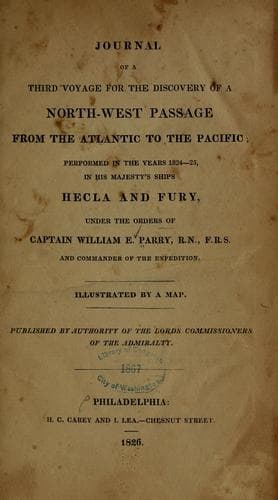
Journal of the Third Voyage for the Discovery of a North-West PassageParry, William Edward, Sir
History
Journal of the Third Voyage for the Discovery of a North-West Passage
Parry, William Edward, Sir
Arctic regions -- Discovery and exploration -- British; Fury (Ship); Hecla (Ship); Northwest Passage
In winter every individual, when in the open air, wears two jackets, of
which the outer one (_Cāppĕ-tēggă_) has the hair outside, and the inner
one (_Attēēgă_) next the body. Immediately on entering the hut the men
take off their outer jacket, beat the snow from it, and lay it by. The
upper garment of the females, besides being cut according to a regular
and uniform pattern, and sewed with exceeding neatness, which is the case
with all the dresses of these people, has also the flaps ornamented in a
very becoming manner by a neat border of deer-skin, so arranged as to
display alternate breadths of white and dark fur. This is, moreover,
usually beautified by a handsome fringe, consisting of innumerable long
narrow threads of leather hanging down from it. This ornament is not
uncommon also in the outer jackets of the men. When seal-hunting they
fasten up the tails of their jackets with a button behind.
Their breeches, of which in winter they also wear two pairs, and
similarly disposed as to the fur, reach below the knee, and fasten with a
string drawn tight round the waist. Though these have little or no
waist-band, and do not come very high, the depth of the jackets, which
considerably overlap them, serves very effectually to complete the
covering of the body.
Their legs and feet are so well clothed, that no degree of cold can well
affect them. When a man goes on a sealing excursion he first puts on a
pair of deer-skin boots (_Allĕktēēgă_) with the hair inside and reaching
to the knee, where they tie. Over these come a pair of shoes of the same
material; next a pair of dressed seal-skin boots perfectly water-tight;
and over all a corresponding pair of shoes, tying round the instep.
These last are made just like the moccasin of a North American Indian,
being neatly crimped at the toes, and having several serpentine pieces of
hide sewn across the sole to prevent wearing. The water-tight boots and
shoes are made of the skin of the small seal (_neitiek_), except the
soles, which consist of the skin of the large seal (_oguke_); this last
is also used for their fishing-lines. When the men are not prepared to
encounter wet they wear an outer boot of deer-skin with the hair outside.
Public-domain text, read in full here on John Shaqi.
Reviews
Reviews
No reviews yet
Be the first to share your thoughts on this work.
Elsewhere in the archive
Join the Discussion
Join the discussion
Sign in to leave a comment or review.
Sign InorCreate an account