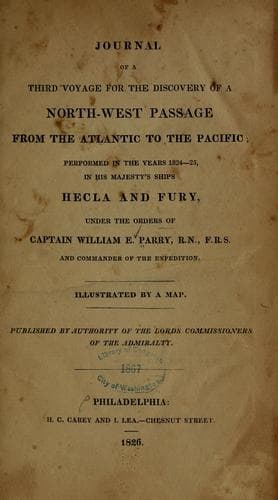
Journal of the Third Voyage for the Discovery of a North-West PassageParry, William Edward, Sir
History
Journal of the Third Voyage for the Discovery of a North-West Passage
Parry, William Edward, Sir
Arctic regions -- Discovery and exploration -- British; Fury (Ship); Hecla (Ship); Northwest Passage
The inner boot of the women, unlike that of the men, is loose round the
leg, coming as high as the knee-joint behind, and in front carried up, by
a long pointed flap, nearly to the waist, and there fastened to the
breeches. The upper boot, with the hair as usual outside, corresponds
with the other in shape, except that it is much more full, especially on
the outer side, where it bulges out so preposterously as to give the
women the most awkward, bow-legged appearance imaginable. This
superfluity of boot has probably originated in the custom, still common
among the native women of Labrador, of carrying their children in them.
We were told that these women sometimes put their children there to
sleep; but the custom must be rare among them, as we never saw it
practised. These boots, however, form their principal pockets, and
pretty capacious ones they are. Here, also, as in the jackets,
considerable taste is displayed in the selection of different parts of
the deer-skin, alternate strips of dark and white being placed up and
down the sides and front by way of ornament. The women also wear a
moccasin (_Itteegĕgă_) over all in the winter time.
One or two persons used to wear a sort of ruff round the neck, composed
of the longest white hair of the deerskin, hanging down over the bosom in
a manner very becoming to young people. It seemed to afford so little
additional warmth to persons already well clothed, that I am inclined
rather to attribute their wearing it to some superstitious notion. The
children between two and eight or nine years of age had a pair of
breeches and boots united in one, with braces over their shoulders to
keep them up. These, with a jacket like the others and a pair of
deer-skin mittens, with which each individual is furnished, constitute
the whole of their dress. Children’s clothes are often made of the skins
of very young fawns and of the marmot, as being softer than those of the
deer.
The Esquimaux, when thus equipped, may at all times bid defiance to the
rigour of this inhospitable climate; and nothing can exceed the
comfortable appearance which they exhibit even in the most inclement
weather. When seen at a little distance the white rim of their hoods,
whitened still more by the breath collecting and freezing upon it, and
contrasted with the dark faces which they encircle, render them very
grotesque objects; but while the skin of their dresses continues in good
condition they always look clean and wholesome.
Public-domain text, read in full here on John Shaqi.
Reviews
Reviews
No reviews yet
Be the first to share your thoughts on this work.
Elsewhere in the archive
Join the Discussion
Join the discussion
Sign in to leave a comment or review.
Sign InorCreate an account