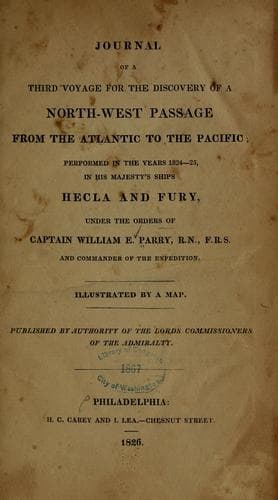
Journal of the Third Voyage for the Discovery of a North-West PassageParry, William Edward, Sir
History
Journal of the Third Voyage for the Discovery of a North-West Passage
Parry, William Edward, Sir
Arctic regions -- Discovery and exploration -- British; Fury (Ship); Hecla (Ship); Northwest Passage
Among their personal ornaments must also be reckoned that mode of marking
the body called tattooing, which, of the customs not essential to the
comfort or happiness of mankind, is perhaps the most extensively
practised throughout the world. Among those people it seems to be an
ornament of indispensable importance to the women, not one of them being
without it. The operation is performed about the age of ten, or
sometimes earlier, and has nothing to do with marriage, except that,
being considered in the light of a personal charm, it may serve to
recommend them as wives. The parts of the body thus marked are their
faces, arms, hands, thighs, and in some few women the breasts, but never
the feet as in Greenland. The operation, which by way of curiosity most
of our gentlemen had practised on their arms, is very expeditiously
managed by passing a needle and thread (the latter covered with
lamp-black and oil) under the epidermis, according to a pattern
previously marked out upon the skin. Several stitches being thus taken
at once, the thumb is pressed upon the part while the thread is drawn
through, by which means the colouring matter is retained, and a permanent
dye of a blue tinge imparted to the skin. A woman expert at this
business will perform it very quickly and with great regularity, but
seldom without drawing blood in many places, and occasioning some
inflammation. Where so large a portion of the surface of the body is to
be covered, it must become a painful as well as tedious process,
especially as, for want of needles, they often use a strip of whalebone
as a substitute. For those parts where a needle cannot conveniently be
passed under the skin they use the method by puncture, which is common in
other countries, and by which our seamen frequently mark their hands and
arms. Several of the men were marked on the back part of their hands;
and with them we understood it to be considered as a souvenir of some
distant or deceased person who had performed it.
Public-domain text, read in full here on John Shaqi.
Reviews
Reviews
No reviews yet
Be the first to share your thoughts on this work.
Elsewhere in the archive
Join the Discussion
Join the discussion
Sign in to leave a comment or review.
Sign InorCreate an account