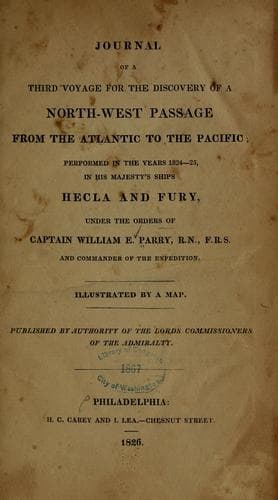
Journal of the Third Voyage for the Discovery of a North-West PassageParry, William Edward, Sir
History
Journal of the Third Voyage for the Discovery of a North-West Passage
Parry, William Edward, Sir
Arctic regions -- Discovery and exploration -- British; Fury (Ship); Hecla (Ship); Northwest Passage
In their winter habitations, I have before mentioned that the only
materials employed are snow and ice, the latter being made use of for the
windows alone. The work is commenced by cutting from a drift of hard and
compact snow a number of oblong slabs, six or seven inches thick and
about two feet in length, and laying them edgeways on a level spot, also
covered with snow, in a circular form, and of a diameter from eight to
fifteen feet, proportioned to the number of occupants the hut is to
contain. Upon this as a foundation is laid a second tier of the same
kind, but with the pieces inclining a little inwards, and made to fit
closely to the lower slabs and to each other, by running a knife adroitly
along the under part and sides. The top of this tier is now prepared for
the reception of a third by squaring it off smoothly with a knife, all
which is dexterously performed by one man standing within the circle and
receiving the blocks of snow from those employed in cutting them without.
When the wall has attained a height of four or five feet, it leans so
much inward as to appear as if about to tumble every moment; but the
workmen still fearlessly lay their blocks of snow upon it, until it is
too high any longer to furnish the materials to the builder in this
manner. Of this he gives notice by cutting a hole close to the ground in
that part where the door is intended to be, which is near the south side,
and through this the snow is now passed. Thus they continue till they
have brought the sides nearly to meet in a perfect and well-constructed
dome, sometimes nine or ten feet high in the centre; and this they take
considerable care in finishing, by fitting the last block or keystone
very nicely in the centre, dropping it into its place from the outside,
though it is still done by the man within. The people outside are in the
meantime occupied in throwing up snow with the _pŏoāllĕrāy_, or
snow-shovel, and in stuffing in little wedges of snow where holes have
been accidentally left.
The builder next proceeds to let himself out by enlarging the proposed
doorway into the form of a Gothic arch three feet high, and two feet and
a half wide at the bottom, communicating with which they construct two
passages, each from ten to twelve feet long and from four to five feet in
height, the lowest being that next the hut. The roofs of these passages
are sometimes arched, but more generally made flat by slabs laid on
horizontally. In first digging the snow for building the hut, they take
it principally from the part where the passages are to be made, which
purposely brings the floor of the latter considerably lower than that of
the hut, but in no part do they dig till the bare ground appears.
Public-domain text, read in full here on John Shaqi.
Reviews
Reviews
No reviews yet
Be the first to share your thoughts on this work.
Elsewhere in the archive
Join the Discussion
Join the discussion
Sign in to leave a comment or review.
Sign InorCreate an account