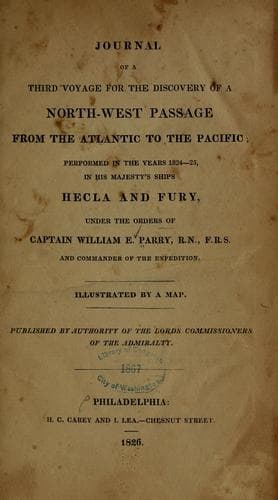
Journal of the Third Voyage for the Discovery of a North-West PassageParry, William Edward, Sir
History
Journal of the Third Voyage for the Discovery of a North-West Passage
Parry, William Edward, Sir
Arctic regions -- Discovery and exploration -- British; Fury (Ship); Hecla (Ship); Northwest Passage
The work just described completes the walls of a hut, if a single
apartment only be required; but if, on account of relationship, or from
any other cause, several families are to reside under one roof, the
passages are made common to all, and the first apartment (in that case
made smaller) forms a kind of ante-chamber, from which you go through an
arched doorway, five feet high, into the inhabited apartments. When
there are three of these, which is generally the case, the whole
building, with its adjacent passages, forms a tolerably regular cross.
For the admission of light into the huts a round hole is cut on one side
of the roof of each apartment, and a circular plate of ice, three or four
inches thick and two feet in diameter, let into it. The light is soft
and pleasant, like that transmitted through ground glass, and is quite
sufficient for every purpose. When after some time these edifices become
surrounded by drift, it is only by the windows, as I have before
remarked, that they could be recognised as human habitations. It may,
perhaps, then be imagined how singular is their external appearance at
night, when they discover themselves only by a circular disc of light
transmitted through the windows from the lamps within.
The next thing to be done is to raise a bank of snow, two and a half feet
high, all round the interior of each apartment, except on the side next
the door. This bank, which is neatly squared off, forms their beds and
fireplace, the former occupying the sides, and the latter the end
opposite the door. The passage left open up to the fireplace is between
three and four feet wide. The beds are arranged by first covering the
snow with a quantity of small stones, over which are laid their paddles,
tent-poles, and some blades of whalebone; above these they place a number
of little pieces of network, made of thin slips of whalebone, and,
lastly, a quantity of twigs of birch and of the _andromeda tetragona_.
Their deer-skins, which are very numerous, can now be spread without risk
of their touching the snow; and such a bed is capable of affording not
merely comfort but luxurious repose, in spite of the rigour of the
climate. The skins thus used as blankets are made of a large size, and
bordered, like some of the jackets, with a fringe of long narrow slips of
leather, in which state a blanket is called _kēipik_.
Public-domain text, read in full here on John Shaqi.
Reviews
Reviews
No reviews yet
Be the first to share your thoughts on this work.
Elsewhere in the archive
Join the Discussion
Join the discussion
Sign in to leave a comment or review.
Sign InorCreate an account