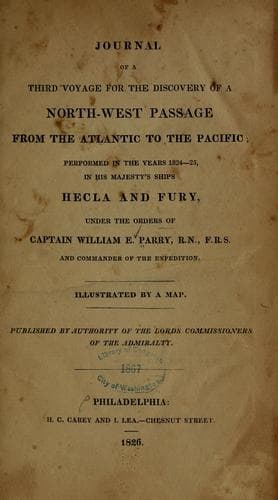
Journal of the Third Voyage for the Discovery of a North-West PassageParry, William Edward, Sir
History
Journal of the Third Voyage for the Discovery of a North-West Passage
Parry, William Edward, Sir
Arctic regions -- Discovery and exploration -- British; Fury (Ship); Hecla (Ship); Northwest Passage
The fire belonging to each family consists of a single lamp, or shallow
vessel of _lapis ollaris_, its form being the lesser segment of a circle.
The wick, composed of dry moss rubbed between the hands till it is quite
inflammable, is disposed along the edge of the lamp on the straight side,
and a greater or smaller quantity lighted, according to the heat required
or the fuel that can be afforded. When the whole length of this, which
is sometimes above eighteen inches, is kindled, it affords a most
brilliant and beautiful light, without any perceptible smoke or any
offensive smell. The lamp is made to supply itself with oil, by
suspending a long thin slice of whale, seal, or sea-horse blubber near
the flame, the warmth of which causes the oil to drip into the vessel
until the whole is extracted. Immediately over the lamp is fixed a rude
and rickety framework of wood, from which their pots are suspended, and
serving also to sustain a large hoop of bone, having a net stretched
tight within it. This contrivance, called _Innĕtăt_, is intended for the
reception of any wet things, and is usually loaded with boots, shoes, and
mittens.
The fireplace, just described as situated at the upper end of the
apartment, has always two lamps facing different ways, one for each
family occupying the corresponding bed-place. There is frequently also a
smaller and less-pretending establishment on the same model—lamp, pot,
net, and all—in one of the corners next the door; for one apartment
sometimes contains three families, which are always closely related, and
no married woman, or even a widow without children, is without her
separate fireplace.
With all the lamps lighted and the hut full of people and dogs, a
thermometer placed on the net over the fire indicated a temperature of
38°; when removed two or three feet from this situation it fell to 31°,
and placed close to the wall stood at 23°, the temperature of the open
air at the time being 25° below zero. A greater degree of warmth than
this produces extreme inconvenience by the dropping from the roofs. This
they endeavour to obviate by applying a little piece of snow to the place
from which a drop proceeds, and this adhering is for a short time an
effectual remedy; but for several weeks in the spring, when the weather
is too warm for these edifices, and still too cold for tents, they suffer
much on this account.
Public-domain text, read in full here on John Shaqi.
Reviews
Reviews
No reviews yet
Be the first to share your thoughts on this work.
Elsewhere in the archive
Join the Discussion
Join the discussion
Sign in to leave a comment or review.
Sign InorCreate an account