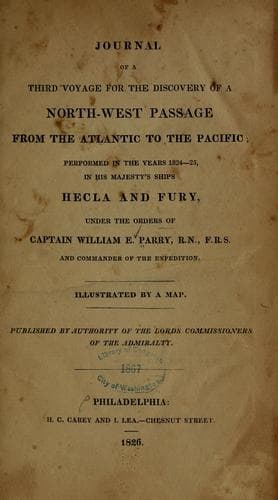
Journal of the Third Voyage for the Discovery of a North-West PassageParry, William Edward, Sir
History
Journal of the Third Voyage for the Discovery of a North-West Passage
Parry, William Edward, Sir
Arctic regions -- Discovery and exploration -- British; Fury (Ship); Hecla (Ship); Northwest Passage
The most important perhaps of the domestic utensils, next to the lamp
already described, are the _ōōtkŏŏsĕĕks_ or stone pots for cooking.
These are hollowed out of solid _lapis ollaris_, of an oblong form, wider
at the top than at the bottom, all made in similar proportion, though of
various sizes, corresponding with the dimensions of the lamp which burns
under it. The pot is suspended by a line of sinew at each end to the
framework over the fire, and thus becomes so black on every side that the
original colour of the stone is in no part discernible. Many of them
were cracked quite across in several places, and mended by sewing with
sinew or rivets of copper, iron, or lead, so as, with the assistance of a
lashing and a due proportion of dirt, to render them quite water-tight.
I may here remark that as these people distinguish the Wager River by the
name of _Oōtkŏŏsĕĕksălik_, we were at first led to conjecture that they
procured their pots, or the material for making them, in that
neighbourhood; this, however, they assured us was not the case, the whole
of them coming from Akkoolee, where the stone is found in very high
situations. One of the women at Winter Island, who came from that
country, said that her parents were much employed in making these pots,
chiefly it seems as articles of barter. The asbestos, which they use in
the shape of a roundish pointed stick called _tatko_ for trimming the
lamps, is met with about Repulse Bay, and generally, as they said, on low
land.
Besides the ootkooseeks, they have circular and oval vessels of whalebone
of various sizes, which, as well as their ivory knives made out of a
walrus’s tusk, are precisely similar to those described on the western
coast of Baffin’s Bay in 1820. They have also a number of smaller
vessels of skin sewed neatly together, and a large basket of the same
material, resembling a common sieve in shape, but with the bottom close
and tight, is to be seen in every apartment. Under every lamp stands a
sort of “save-all,” consisting of a small skin basket for catching the
oil that falls over. Almost every family was in possession of a wooden
tray very much resembling those used to carry butcher’s meat in England,
and of nearly the same dimensions, which we understood them to have
procured by way of Noowook. They had a number of the bowls or cups
already once or twice alluded to as being made out of the thick root of
the horn of the musk-ox. Of the smaller part of the same horn they also
form a convenient drinking-cup, sometimes turning it up artificially
about one-third from the point, so as to be almost parallel to the other
part, and cutting it full of small notches as a convenience in grasping
it. These, or any other vessels for drinking, they call _Immōōchiuk_.
Public-domain text, read in full here on John Shaqi.
Reviews
Reviews
No reviews yet
Be the first to share your thoughts on this work.
Elsewhere in the archive
Join the Discussion
Join the discussion
Sign in to leave a comment or review.
Sign InorCreate an account