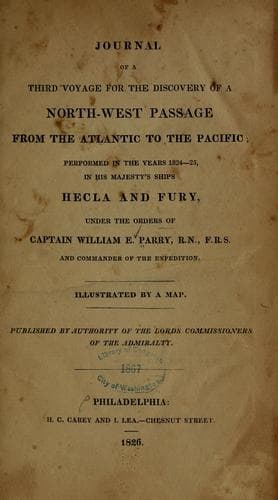
Journal of the Third Voyage for the Discovery of a North-West PassageParry, William Edward, Sir
History
Journal of the Third Voyage for the Discovery of a North-West Passage
Parry, William Edward, Sir
Arctic regions -- Discovery and exploration -- British; Fury (Ship); Hecla (Ship); Northwest Passage
Besides the ivory knives, the men were well supplied with a much more
serviceable kind, made of iron, and called _panna_. The form of this
knife is very peculiar, being seven inches long, two and a quarter broad,
quite straight and flat, pointed at the end, and ground equally sharp at
both edges; this is firmly secured into a handle of bone or wood, about a
foot long, by two or three iron rivets, and has all the appearance of a
most destructive spear-head, but is nevertheless put to no other purpose
than that of a very useful knife, which the men are scarcely ever
without, especially on their sealing excursions. For these, and several
knives of European form, they are probably indebted to an indirect
communication with our factories in Hudson’s Bay. The same may be
observed of the best of their women’s knives (_ooloo_), on one of which,
of a larger size than usual, were the names of “Wild and Sorby.” When of
their own manufacture, the only iron part was a little narrow slip let
into the bone and secured by rivets. It is curious to observe in this,
and in numerous other instances, how exactly, amidst all the diversity of
time and place, these people have preserved unaltered their manners and
habits as mentioned by Crantz. That which an absurd dread of innovation
does in China, the want of intercourse with other nations has effected
among the Esquimaux.
Of the horn of the musk-ox they make also very good spoons much like ours
in shape; and I must not omit to mention their marrow spoons
(_pattēkniuk_, from _pāttĕk_, marrow), made out of long, narrow, hollowed
pieces of bone, of which every housewife has a bunch of half a dozen or
more tied together, and generally attached to her needle-case.
For the purpose of obtaining fire the Esquimaux use two lumps of common
iron pyrites, from which sparks are struck into a little leathern case
containing moss well dried and rubbed between the hands. If this tinder
does not readily catch, a small quantity of the white floss of the seed
of the ground willow is laid above the moss. As soon as a spark has
caught, it is gently blown till the fire has spread an inch around, when,
the pointed end of a piece of oiled wick being applied, it soon bursts
into a flame, the whole process having occupied perhaps two or three
minutes.
Among the articles in their possession, which must have been obtained by
communication along shore with Hudson’s Bay, were two large copper
kettles, several open knives with crooked wooden handles, and many
fragments of copper, iron, and old files. On a small European axe was
observed the name of “Foster.”
Public-domain text, read in full here on John Shaqi.
Reviews
Reviews
No reviews yet
Be the first to share your thoughts on this work.
Elsewhere in the archive
Join the Discussion
Join the discussion
Sign in to leave a comment or review.
Sign InorCreate an account