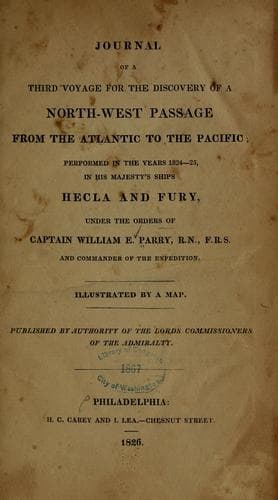
Journal of the Third Voyage for the Discovery of a North-West PassageParry, William Edward, Sir
History
Journal of the Third Voyage for the Discovery of a North-West Passage
Parry, William Edward, Sir
Arctic regions -- Discovery and exploration -- British; Fury (Ship); Hecla (Ship); Northwest Passage
Their only drink is water; and of this, when they can procure it, they
swallow an inconceivable quantity; so that one of the principal
occupations of the women during the winter is the thawing of snow in the
ootkooseks for this purpose. They cut it into thin slices, and are
careful to have it clean, on which account they will bring it from a
distance of fifty yards from the huts. They have an extreme dislike to
drinking water much above the temperature of 32°. In eating their meals
the mistress of the family, having previously cooked the meat, takes a
large lump out of the pot with her fingers, and hands it to her husband,
who placing a part of it between his teeth cuts it off with a large knife
in that position, and then passes the knife and meat together to his next
neighbour. In cutting off a mouthful of meat the knife passes so close
to their lips, that nothing but constant habit could ensure them from the
danger of the most terrible gashes; and it would make an English mother
shudder to see the manner in which children, five or six years old, are
at all times freely trusted with a knife to be used in this way.
The length of one of the best of seven canoes belonging to these
Esquimaux was twenty-five feet, including a narrow-pointed projection,
three feet long at each end, which turns a little upward from the
horizontal. The extreme breadth, which is just before the circular hole,
was twenty-one inches, and the depth ten inches and a half. The plane of
the upper surface of the canoe, except in the two extreme projections,
bends downwards a little from the centre towards the head and stern,
giving it the appearance of what is in ships called “broken-backed.” The
gunwales are of fir, in some instances of one piece, three or four inches
broad in the centre and tapering gradually away towards the ends. The
timbers, as well as the fore-and-aft connecting pieces, are of the same
material, the former being an inch square, and sometimes so close
together as to require between forty and fifty of them in one canoe:
which when thus “in frame” is one of the prettiest things of the kind
that can be imagined. The skin with which the canoe is covered is
exclusively that of the _neitiek_, prepared by scraping off the hair and
fat with an _ooloo_, and stretching it tight on a frame over the fire;
after which and a good deal of chewing, it is sewn on by the women with
admirable neatness and strength. Their paddles have a blade at each end,
the whole length being nine feet and a half; the blades are covered with
a narrow plate of bone round the ends to secure them from splitting: they
are always made of fir, and generally of several pieces scarfed and
woolded together.
Public-domain text, read in full here on John Shaqi.
Reviews
Reviews
No reviews yet
Be the first to share your thoughts on this work.
Elsewhere in the archive
Join the Discussion
Join the discussion
Sign in to leave a comment or review.
Sign InorCreate an account