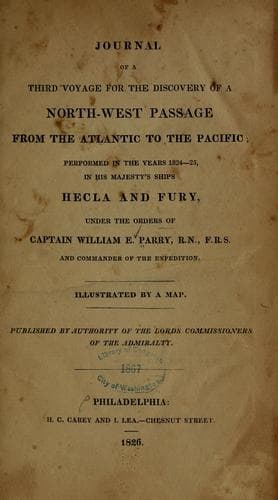
Journal of the Third Voyage for the Discovery of a North-West PassageParry, William Edward, Sir
History
Journal of the Third Voyage for the Discovery of a North-West Passage
Parry, William Edward, Sir
Arctic regions -- Discovery and exploration -- British; Fury (Ship); Hecla (Ship); Northwest Passage
On the 17th, when we had driven back rather to the eastward of Admiralty
Inlet, an easterly breeze again enabled us to make some progress. The
sea was now for the most part covered with young ice, which had become so
thick as to look white throughout its whole extent. The holes of water
could now, therefore, be more distinctly seen, and by taking advantage of
these we succeeded in making a few miles of westing, the “leads” taking
us more in-shore, towards Admiralty Inlet, than before. Towards sunset
we became more and more hampered, and were eventually beset during the
night. A breeze sprang up from the westward, which increasing to a fresh
gale, we found ourselves at daylight far to the eastward, and also within
two miles of the land, near a long low point, which on the former voyages
had not been seen. The sea was covered with ice between us and the
shore, all of this year’s formation, but now of considerable thickness
and formidable appearance. The wind continuing strong, the whole body
was constantly pressed in upon the land, bearing the ships along with it,
and doubling one sheet over another, sometimes to a hundred thicknesses.
We quickly shoaled the water from seventy to forty fathoms, the latter
depth occurring about a mile from the beach; and after this we drifted
but little, the ice being blocked up between the point and a high
perpendicular berg lying aground off it.
The sails being furled, and the top-gallant yards got down, we now
considered ourselves fortunate in our situation; for had we been only a
quarter of a mile farther out we should have been within the influence of
a current that was there sweeping the whole body of ice to the eastward,
at the rate of a mile and a half an hour. Indeed, at times this current
was disposed to approach us still nearer, carrying away pieces of ice
close to our quarter; but by means of long hawsers, secured to the
heaviest and most compact of the small floes in-shore of us, we contrived
to hold on. Under such circumstances, it evidently became expedient to
endeavour, by sawing, to get the ships as close in-shore as possible, so
as to secure them either to grounded ice or by anchoring within the
shelter of a bay at no great distance inside of us; for it now seemed not
unlikely that winter was about to put a premature stop to all further
operations at sea for this season. At all events it was necessary to
consult the immediate safety of the ships, and to keep them from being
drifted back to the eastward. I therefore gave orders for endeavouring
to get the ships in towards the bay by cutting through what level floes
still remained. At the same time an officer was despatched to examine
the shore, which was found safe, with regular soundings in every part.
So strong had been the pressure while the ice was forcing in upon us,
that on the 20th, after liberating the _Hecla_ on one side, she was as
firmly cemented to it on the other as after a winter’s formation, and we
Public-domain text, read in full here on John Shaqi.
Reviews
Reviews
No reviews yet
Be the first to share your thoughts on this work.
Join the Discussion
Join the discussion
Sign in to leave a comment or review.
Sign InorCreate an account