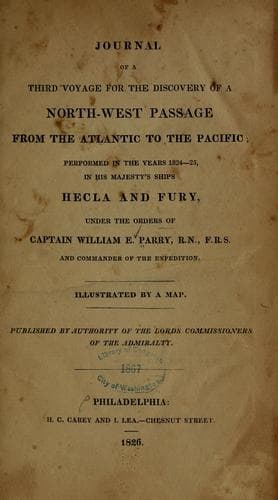
Journal of the Third Voyage for the Discovery of a North-West Passage — John Shaqi
Journal of the Third Voyage for the Discovery of a North-West PassageParry, William Edward, Sir
History
Journal of the Third Voyage for the Discovery of a North-West Passage
Parry, William Edward, Sir
Arctic regions -- Discovery and exploration -- British; Fury (Ship); Hecla (Ship); Northwest Passage
could only clear her by heavy and repeated “sallying.” After cutting in
two or three hundred yards, while the people were at dinner on the 21st,
our canal closed, by the external pressure coming upon the parts which we
had weakened, and in a few minutes the whole was once more in motion, or,
as the seamen not inaptly expressed it, “alive,” mass doubling under
mass, and raising those which were uppermost to a considerable height.
The ice thus pressed together was now about ten feet in thickness in some
places, and on an average not less than four or five, so that while thus
forced in upon a ship, although soft in itself, it caused her to tremble
exceedingly; a sensation, indeed, commonly experienced in forcing through
young ice of considerable thickness. We were now once more obliged to be
quiet spectators of what was going on around us, having with extreme
difficulty succeeded in saving most of our tools that were lying on the
ice when the squeezing suddenly began. Towards evening we made fast to a
stationary floe, at the distance of one mile from the beach, in eighteen
fathoms, where we remained tolerably quiet for the night, the ice outside
of us, and as far as we could see, setting constantly at a great rate to
the eastward. Some of our gentlemen, who had landed in the course of the
day, and who had to scramble their way on board over the ice in motion,
described the bay as deeper than it appeared from the offing. Dr. Neill
“found, on such parts of the beach as were not covered with ice or snow,
fragments of bituminous shale, flinty slate, and iron-stone, interspersed
amongst a blue-coloured limestone gravel. As far as he was able to
travel inland, the surface was composed of secondary limestone, partially
covered with a thin layer of calc-sinter. From the scantiness of the
vegetation here, the limestone seemed likely to contain a large
proportion of magnesia. Dr. Neill was about to examine for coal, which
the formation led him to expect, when the ice was observed to be in
motion, obliging him hastily to return on board.” Lieutenant Ross
“found, about two-thirds up a small peaked insulated hill of limestone,
between three and four hundred feet above the level of the sea, several
pieces of coal, which he found to burn with a clear bright flame,
crackling much, and throwing off slaty splinters.”
Hares’ burrows were numerous on this hill; Lieutenant Ross saw two of
these animals, one of which he killed. A fox was also observed in its
summer dress; and these, with a pair of ravens, some wingless ducks, and
several snow-buntings, were all the animals noticed at this place.
Public-domain text, read in full here on John Shaqi.
Reviews
Reviews
No reviews yet
Be the first to share your thoughts on this work.
Join the Discussion
Join the discussion
Sign in to leave a comment or review.
Sign InorCreate an account