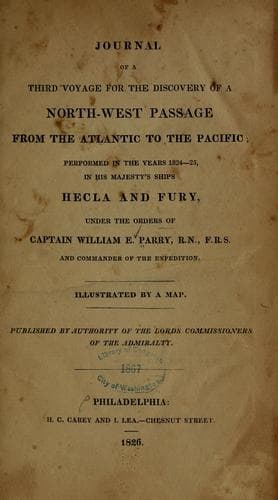
Journal of the Third Voyage for the Discovery of a North-West PassageParry, William Edward, Sir
History
Journal of the Third Voyage for the Discovery of a North-West Passage
Parry, William Edward, Sir
Arctic regions -- Discovery and exploration -- British; Fury (Ship); Hecla (Ship); Northwest Passage
The dogs of the Esquimaux, of which these people possessed above a
hundred, have been so often described that there may seem little left to
add respecting their external appearance, habits, and use. Our visits to
Igloolik having, however, made us acquainted with some not hitherto
described, I shall here offer a further account of these invaluable
animals. In the form of their bodies, their short pricked ears, thick
furry coat, and bushy tail, they so nearly resemble the wolf of these
regions that, when of a light or brindled colour, they may easily at a
little distance be mistaken for that animal. To an eye accustomed to
both, however, a difference is perceptible in the wolf’s always keeping
his head down and his tail between his legs in running, whereas the dogs
almost always carry their tails handsomely curled over the back. A
difference less distinguishable, when the animals are apart, is the
superior size and more muscular make of the wild animal, especially about
the breast and legs. The wolf is also, in general, full two inches
taller than any Esquimaux dog we have seen; but those met with in 1818,
in the latitude of 76°, appear to come nearest to it in that respect.
The tallest dog at Igloolik stood two feet one inch from the ground,
measured at the withers; the average height was about two inches less
than this.
The colour of the dogs varies from a white, through brindled, to
black-and-white, or almost entirely black. Some are also of a reddish or
ferruginous colour, and others have a brownish-red tinge on their legs,
the rest of their bodies being of a darker colour, and these last were
observed to be generally the best dogs. Their hair in the winter is from
three to four inches long; but besides this, Nature furnishes them during
this rigorous season with a thick under-coating of close soft wool, which
they begin to cast in the spring. While thus provided, they are able to
withstand the most inclement weather without suffering from the cold; and
at whatever temperature the atmosphere may be, they require nothing but a
shelter from the wind to make them comfortable, and even this they do not
always obtain. They are also wonderfully enabled to endure the cold even
on those parts of the body which are not thus protected, for we have seen
a young puppy sleeping, with its bare paw laid on an ice-anchor, with the
thermometer at -30°, which with one of our dogs would have produced
immediate and intense pain, if not subsequent mortification. They never
bark, but have a long melancholy howl like that of the wolf, and this
they will sometimes perform in concert for a minute or two together.
They are besides always snarling and fighting among one another, by which
several of them are generally lame. When much caressed and well fed,
they become quite familiar and domestic; but this mode of treatment does
not improve their qualities as animals of draught. Being desirous of
Public-domain text, read in full here on John Shaqi.
Reviews
Reviews
No reviews yet
Be the first to share your thoughts on this work.
Elsewhere in the archive
Join the Discussion
Join the discussion
Sign in to leave a comment or review.
Sign InorCreate an account