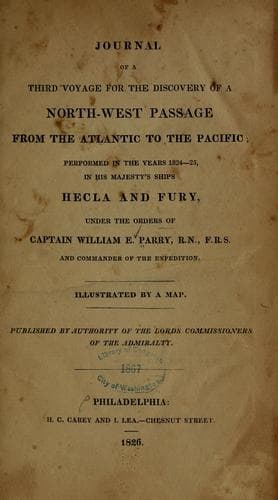
Journal of the Third Voyage for the Discovery of a North-West PassageParry, William Edward, Sir
History
Journal of the Third Voyage for the Discovery of a North-West Passage
Parry, William Edward, Sir
Arctic regions -- Discovery and exploration -- British; Fury (Ship); Hecla (Ship); Northwest Passage
ascertaining whether these dogs are wolves in a state of domestication, a
question which we understood to have been the subject of some
speculation, Mr. Skeoch, at my request, made a skeleton of each, when the
number of all the vertebra was found to be the same in both, and to
correspond with the well-known anatomy of the wolf.
When drawing a sledge, the dogs have a simple harness (_annoo_) of deer
or seal skin, going round the neck by one bight, and another for each of
the fore-legs, with a single thong leading over the back and attached to
the sledge as a trace. Though they appear at first sight to be huddled
together without regard to regularity, there is, in fact, considerable
attention paid to their arrangement, particularly in the selection of a
dog of peculiar spirit and sagacity, who is allowed, by a longer trace,
to precede the rest as leader, and to whom, in turning to the right or
left, the driver usually addresses himself. This choice is made without
regard to age or sex, and the rest of the dogs take precedency according
to their training or sagacity, the least effective being put nearest the
sledge. The leader is usually from eighteen to twenty feet from the fore
part of the sledge, and the hindmost dog about half that distance, so
that when ten or twelve are running together, several are nearly abreast
of each other. The driver sits quite low on the fore part of the sledge,
with his feet overhanging the snow on one side, and having in his hand a
whip, of which the handle, made either of wood, bone, or whalebone, is
eighteen inches, and the lash more than as many feet in length. The part
of the thong next the handle is plaited a little way down to stiffen it
and give it a spring, on which much of its use depends; and that which
composes the lash is chewed by the women to make it flexible in frosty
weather. The men acquire from their youth considerable expertness in the
use of this whip, the lash of which is left to trail along the ground by
the side of the sledge, and with which they can inflict a very severe
blow on any dog at pleasure. Though the dogs are kept in training
entirely by fear of the whip, and indeed without it would soon have their
own way, its immediate effect is always detrimental to the draught of the
sledge; for not only does the individual that is struck draw back and
slacken his trace, but generally turns upon his next neighbour, and this,
passing on to the next, occasions a general divergency, accompanied by
the usual yelping and showing of teeth. The dogs then come together
again by degrees, and the draught of the sledge is accelerated; but, even
at the best of times, by this rude mode of draught, the traces of
one-third of the dogs form an angle of thirty or forty degrees on each
side of the direction in which the sledge is advancing. Another great
inconvenience attending the Esquimaux method of putting the dogs to,
besides that of not employing their strength to the best advantage, is
Public-domain text, read in full here on John Shaqi.
Reviews
Reviews
No reviews yet
Be the first to share your thoughts on this work.
Elsewhere in the archive
Join the Discussion
Join the discussion
Sign in to leave a comment or review.
Sign InorCreate an account