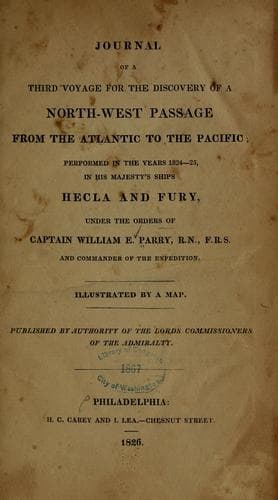
Journal of the Third Voyage for the Discovery of a North-West PassageParry, William Edward, Sir
History
Journal of the Third Voyage for the Discovery of a North-West Passage
Parry, William Edward, Sir
Arctic regions -- Discovery and exploration -- British; Fury (Ship); Hecla (Ship); Northwest Passage
the constant entanglement of the traces by the dogs repeatedly doubling
under from side to side to avoid the whip, so that, after running a few
miles, the traces always require to be taken off and cleared.
In directing the sledge the whip acts no very essential part, the driver
for this purpose using certain words, as the carters do with us, to make
the dogs turn more to the right or left. To these a good leader attends
with admirable precision, especially if his own name be repeated at the
same time, looking behind over his shoulder with great earnestness, as if
listening to the directions of the driver. On a beaten track, or even
where a single foot or sledge mark is occasionally discernible, there is
not the slightest trouble in guiding the dogs; for even in the darkest
night and in the heaviest snowdrift there is little or no danger of their
losing the road, the leader keeping his nose near the ground, and
directing the rest with wonderful sagacity. Where, however, there is no
beaten track, the best driver among them makes a terribly circuitous
course, as all the Esquimaux roads plainly show; these generally
occupying an extent of six miles, when with a horse and sledge the
journey would scarcely have amounted to five. On rough ground, as among
hummocks of ice, the sledge would be frequently overturned, or altogether
stopped, if the driver did not repeatedly get off, and, by lifting or
drawing it to one side, steer it clear of those accidents. At all times,
indeed, except on a smooth and well-made road, he is pretty constantly
employed thus with his feet, which, together with his never-ceasing
vociferations and frequent use of the whip, renders the driving of one of
these vehicles by no means a pleasant or easy task. When the driver
wishes to stop the sledge, he calls out “Wo, woa,” exactly as our carters
do; but the attention paid to this command depends altogether on his
ability to enforce it. If the weight is small and the journey homeward,
the dogs are not to be thus delayed; the driver is therefore obliged to
dig his heels into the snow to obstruct their progress; and having thus
succeeded in stopping them, he stands up with one leg before the foremost
cross-piece of the sledge, till, by means of laying the whip gently over
each dog’s head, he has made them all lie down. He then takes care not
to quit his position; so that should the dogs set off he is thrown upon
the sledge, instead of being left behind by them.
Public-domain text, read in full here on John Shaqi.
Reviews
Reviews
No reviews yet
Be the first to share your thoughts on this work.
Elsewhere in the archive
Join the Discussion
Join the discussion
Sign in to leave a comment or review.
Sign InorCreate an account