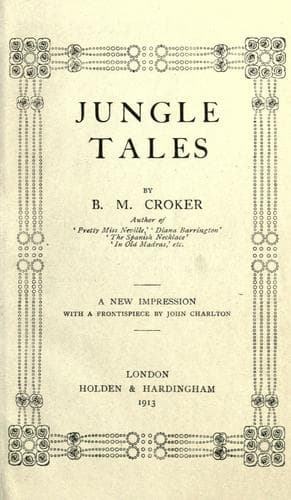
British -- India -- Fiction; India -- History -- British occupation, 1765-1947 -- Fiction; Short stories
ground, ropes were thrown to him, but, alas! it was all of no avail;
the morass was a peculiarly bad one, and his powerless hind quarters
were unable to complete the effort and land him safely. No, the cruel
quagmire slowly, surely, and remorselessly sucked him down; and, after
a most determined effort on the part of the spectators, and a frenzied
but impotent struggle on his own, Tom turned to me and exclaimed--
“Poor old boy! it’s not a bit of good; he will have to go!”
“Go where?” I cried. “He can be saved; he must be saved,” I added,
hysterically.
“Impossible; he has not sufficient power to raise himself; the ground
is a sort of quicksand. If there was another elephant here, we might
manage to haul him out; but, as it is, it is a mere question of
time--he will be gone in half an hour.”
I wept, implored, ran about like one demented, begging, bribing,
entreating the natives to help. And, I must confess, they all did
their very best, nobly led by Tom and Charlie. But their efforts were
fruitless. Shere Bahadur’s hour had come. He had escaped bullets,
grape-shot, and tiger, to be gradually swallowed down by that slimy
black quagmire, and--horrible thought--buried alive! At the end of
a quarter of an hour he had sunk up to his ears, and had ceased to
struggle. His trunk was still above the mud. His poor hidden sides!--we
could hear them going like the paddle-wheels of a steamer. It appeared
to me that his eye sought mine!
Oh, I could endure the scene no longer. I left the crowd to see the
very end, rushed back to the tent, flung myself on my bed, covered
up my head, and wept myself nearly blind. It seemed hours and
hours--twenty-four hours--before Tom came in, and said, as solemnly as
if he were announcing the death of a friend, “It is all over.”
* * * * *
The detestable mahout over-acted his part; at first he simulated
frenzy, his grief far surpassed mine, he gibbered, wept, and beat
his breast, and rolled upon the ground at our feet in a paroxysm of
anguish, as he assured us that the rajah was a ruthless lord, and
that when he returned to Betwa without the Hathi he would certainly
be put to torture, and subsequently to death. And then Tom suddenly
bethought himself of the terms of the agreement. The elephant had _not_
died a natural death. No, he had “gone down quick into the pit.” He
was dead, and Tom was bound to pay two thousand rupees (about £150).
He looked exceedingly glum, but there was no other alternative; yes,
he must pay--even if he could not contrive to look pleasant. He most
reluctantly sent the rajah a cheque for the amount on the Bank of
Bengal, and the mahout departed with somewhat suspicious alacrity,
leaving the howdah behind him.
Public-domain text, read in full here on John Shaqi.
Reviews
Reviews
No reviews yet
Be the first to share your thoughts on this work.
Join the Discussion
Join the discussion
Sign in to leave a comment or review.
Sign InorCreate an account