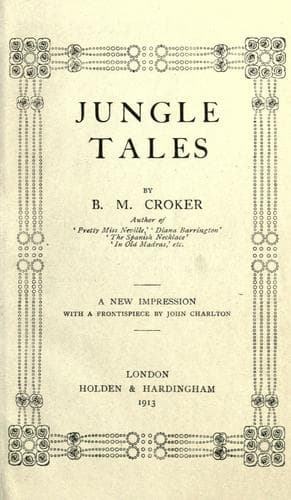
British -- India -- Fiction; India -- History -- British occupation, 1765-1947 -- Fiction; Short stories
Afterwards, we became acquainted with two extraordinary facts. One was
that the rajah had carefully arranged for the death of the elephant,
even before we left our first camp; that the mahout’s so-called
brother was simply a special messenger, who had been despatched to
“hurry up” the tragedy. Discovery the second, that the mahout had been
seen by our shikarri and several other men deliberately goading and
urging the elephant into the quagmire. The wise animal had at first
steadily resisted, but putting implicit faith in his rider--who had
driven him for years--and being the most docile of his race, he had
ultimately yielded, and obediently waded in to his death. At first we
indignantly refused to credit these stories, and declared that they
were merely the ordinary malicious native slander; but subsequently a
slip of copy-book paper was discovered in the pocket of the howdah,
which, being interpreted by Tom, read as follows--
“Make no delay. Bad quagmire. Give fifty rupees.--Betwa.”
And Shere Bahadur was betrayed for that sum.
We received in due time an effusive letter from the Rajah of Betwa,
written, as usual, on the leaf of a copy-book, and inscribed with
numerous ornamental flourishes. He also enclosed a formal stamped
receipt, which is on my bill-file at the present moment, and is not the
least remarkable of the many curious documents there impaled. It says--
“Received from Mister Captain Thomas Hay, the sum of two thousand
government rupees, the value of one War elephant--lost!”
“PROVEN OR NOT PROVEN?”
THE TRUE STORY OF NAIM SING, RAJPOOT.
Look around, and above, with your mind’s eye, and behold high hills
and deep narrow valleys--valleys overflowing with corn, and hills
speckled with flocks; no, these are not the Alps,--nor yet the Andes;
the sturdy brown people have the Tartar type of face, their stubborn,
shaggy ponies are of Thibetan breed. You stand on the borders of
Nepaul, and among the lower slopes of the great Himalayas--a remote
district, but tolerably populated and prosperous. There are many
snug, flat-roofed houses scattered up and down the niches in these
staircase-like heights, encompassed with cowsheds, melon gardens,
groves of walnut trees, and a few almost perpendicular acres of murga
(grain); their proprietors are well-to-do, their wants inconsiderable,
the possession of a pony, half a dozen goats, and a couple of milch
buffaloes, constitutes a man of means, who is as happy in his way as,
perhaps happier than, the English or Irish owner of a great landed
estate. Moreover, this pastoral life has its pleasures: there are
holy festivals, fairs, feasts, wrestling-matches,--and occasionally a
little gambling and cock-fighting. But even in these primitive mountain
regions, life is not _all_ Arcadian simplicity; there are black spots
on the sun of its existence, such as envy, hatred, malice, jealousy,
false-witness, and murder.
Public-domain text, read in full here on John Shaqi.
Reviews
Reviews
No reviews yet
Be the first to share your thoughts on this work.
Join the Discussion
Join the discussion
Sign in to leave a comment or review.
Sign InorCreate an account