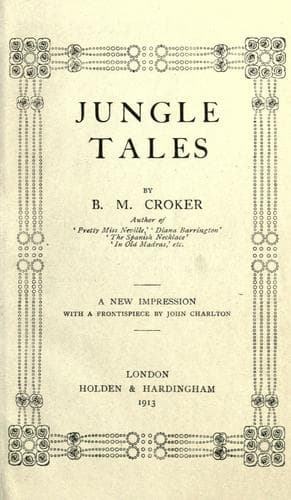
British -- India -- Fiction; India -- History -- British occupation, 1765-1947 -- Fiction; Short stories
It was indeed a grand tamasha. The crowds far surpassed in numbers
those who assembled at the yearly feast. The local inhabitants noted
with complacency the hundreds of total strangers who came for many
miles on foot, on ponies, or in ekkas. Old Sona ceased now to scream
and beat her breast. She felt like one of the actors in a tremendous
tragedy, and was the object of a certain amount of curiosity and
attention--a position that was entirely novel, and--alas! alas! that
it must be chronicled--secretly enjoyed. The sun rose on the fatal
day--the last sunrise Jasoda would ever see--the great prison gates
opened, and a body of police marched slowly forth. Then came Jasoda,
walking between two warders. There was a murmur among the throng. She
was surprisingly fair to behold, and for once in her life she wore a
dress like girls of her class. A wealthy and eccentric woman in the
city had sent it to her. Yes, she was as fair as the newly risen dawn.
She stood and steadily surveyed the immense expectant multitude. She
recognized the eyes of many people from her own village fixed upon her
with a mixture of interest and awe. She beheld her old grandmother,
and her brother, and Moonee, and Pathoo, and Jai Singh, the son of
Herk Singh, who had compared her to Parbutti herself and to the new
moon. It seemed to her that to be the centre of interest to so vast a
throng was almost as fine as a suttee! The last moment arrived, and the
superintendent asked her if she had anything to say, any bequests to
make.
“Bequests!” and she almost laughed. “Truly I have nothing in the world
save a few rags. But thou mayest give my body to my grandmother; she
seems sorry. I have nothing to say. The child hurt me, and I struck
her. I meant not to kill her; nevertheless, she died; that is all. She
is dead, and I shall soon be dead also.”
Jasoda’s fortitude did not fail her--no, not when her arms were
pinioned, her petticoats tied about her feet, the cap drawn over her
face. She never once quailed or trembled.
* * * * *
When the body had been cut down, and the crowd had dispersed, the
superintendent sent for the old grandmother, who came, dry-eyed and
fierce.
“It is somewhat against rules,” he said, “but I am going to grant you
the girl’s only request: she said you were to have her body--take it
away, and burn it!”
“I!” shrieked the harridan. “_I_ touch her after the dones (hangmen)
have laid their hands on her! _I_, a high-caste Braminee! Do with the
carrion as thou wilt!” and she spat on the ground and went her way.
Thus, after death, neglect and scorn pursued poor hot-tempered Jasoda,
even to the grave.
Public-domain text, read in full here on John Shaqi.
Reviews
Reviews
No reviews yet
Be the first to share your thoughts on this work.
Join the Discussion
Join the discussion
Sign in to leave a comment or review.
Sign InorCreate an account