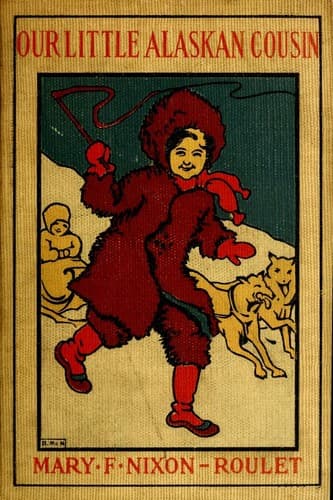
Kalitan, Our Little Alaskan CousinNixon-Roulet, Mary F.
General
Kalitan, Our Little Alaskan Cousin
Nixon-Roulet, Mary F.
Children -- Alaska -- Juvenile literature
"What a queer canoe that Indian has!" exclaimed Ted. "It isn't a bit
like yours, Kalitan."
"It is _bidarka_," said Kalitan. "Kadiak people make canoe out of walrus
hide. They stretch it over frames of driftwood. It holds two people.
They sit in small hatch with apron all around their bodies, and the
_bidarka_ goes over the roughest sea and floats like a bladder. Big
_bidarka_ called an _oomiak_, and holds whole family."
"Some one has called the _bidarkas_ the 'Cossacks of the sea,'" said Mr.
Strong. "They skim along like swallows, and are as perfectly built as
any vessel I ever saw."
"What are those huge buildings on the small island?" asked Ted, as the
steamer wound through the shallows.
"Ice-houses," said his father. "Before people learned to manufacture
ice, immense cargoes were shipped from here to as far south as San
Francisco."
"It was fun to see them go fishing for ice from the steamer when we came
up to Skaguay," said Ted. "The sailors went out in a boat, slipped a
net around a block of ice and towed it to the side of the ship, then it
was hitched to a derrick and swung on deck."
"Huh!" said Kalitan. "What people want ice for stored up? Think they'd
store sunshine!"
"If you could invent a way to do that, you could make a fortune, my
boy," said Mr. Strong, laughing. "The next place of any interest is
Karluk. It's around on the other side of the island in Shelikoff Strait,
and is famous for its salmon canneries. Nearly half of the entire salmon
pack of Alaska comes from Kadiak Island, most of the fish coming from
the Karluk River."
"Very bad for Indians," said Kalitan. "Used to have plenty fish. Tyee
Klake said salmon used to come up this river in shoal sixteen miles
long, and now Boston men take them all."
"It does seem a pity that the Indians don't even have a chance to earn
their living in the canneries," said Mr. Strong. "The largest cannery in
the world is at Karluk. There are thousands of men employed, and in one
year over three million salmon were packed, yet with all this work for
busy hands to do, the canneries employ Chinese, Greek, Portuguese, and
American workmen in preference to the Indians, bringing them by the
shipload from San Francisco."
"What other places do we pass?" asked Ted.
"A lot of very interesting ones, and I wish we could coast along,
stopping wherever we felt like it," said Mr. Strong. "The Shumagin
Islands are where Bering, the great discoverer and explorer, landed in
1741 to bury one of his crew. Codfish were found there, and Captain
Cook, in his 'Voyages and Discoveries,' speaks of the same fish. There
is a famous fishery there now called the Davidson Banks, and the
codfishing fleet has its headquarters on Popoff Island. Millions of
codfish are caught here every year. These islands are also a favourite
haunt of the sea otter. Belofsky, at the foot of Mt. Pavloff, is the
centre of the trade."
[Illustration: MOUNT SHISHALDIN.]
Public-domain text, read in full here on John Shaqi.
Reviews
Reviews
No reviews yet
Be the first to share your thoughts on this work.
Join the Discussion
Join the discussion
Sign in to leave a comment or review.
Sign InorCreate an account